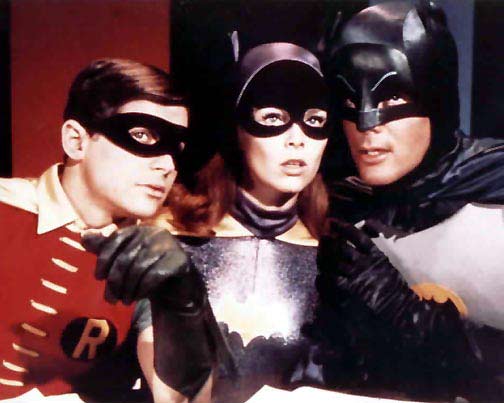
On Monday actress Yvonne Craig lost her
grueling two-year battle with breast cancer. Of course everyone knew her as “Batgirl” from the classic 1960s television series, but she made memorable impressions on other well-loved series such as Star Trek, The Mod Squad, 77 Sunset Strip, Voyage to the Bottom of the Sea, The Man from U.N.C.L.E., The Wild Wild West, and many others. She appeared twice on film with Elvis Presley. Her trained dancer’s figure made her a popular glamour, pin-up and ad model during her heyday, and her long film and television resume belies the fact that she did not originally pursue an acting career.
One of the most startling results of time’s relentless passage is when you wake up and realize that somebody you lusted after in your youth has suddenly turned, well, old. That phenomenon struck me when actress Susan Saint James, of McMillan & Wife fame, celebrated her 60th birthday in 2006, and again when The Avengers’ Diana Rigg turned 70 just two years after that. How could these small-screen beauties be clocking so many birthdays when I still thought of them as nubile 20-somethings?
I’m in the grip of that same peculiar nostalgia today, as I note the 70th birthday of Sherry Jackson.
Although this Idaho-born actress made her film debut at age 7, was featured in a few of the Ma and Pa Kettle comedies of the 1950s, and was a regular on The Danny Thomas Show (aka Make Room for Daddy) from 1953 to 1958, playing Thomas’ daughter, my immediate memory of Jackson always casts her as Andrea, the supposedly unemotional android she played in “What Are Little Girls Made Of?,” one of the earliest episodes of Star Trek. Andrea, as any veteran Trekkie can tell you, was the alluringly attired sexual companion of medical archaeologist Dr. Roger Korby, a man who once sparked the passions of the Enterprise’s Nurse Christine Chapel (Majel Barrett).
I’m embedding a significant scene from that episode below. Jackson is of course the chestnut-tressed, full-lipped, cleft-chinned temptress in the cleavage-showcasing crossover top:
When she shot that memorable episode, Jackson was a mere 24 years old. Yet that’s the way she remains in my mind’s eye.
During the decades since I first watched “What Are Little Girls Made Of?,” I’ve spotted her in a variety of other productions, from 77 Sunset Strip and Perry Mason to My Three Sons, Love, American Style, and The Rockford Files. She featured in twoinstallments of the oft-campy TV series Batman, playing The Riddler’s once again skimpily outfitted cohort, Pauline. She guest-starred on Lost in Space, Matt Helm, The Streets of San Francisco, Barnaby Jones, Switch, and The Incredible Hulk; notched up two showings on The Wild Wild West; and did another turn with Star Trek’s William Shatner, this time playing a San Francisco casino dealer in his 1975-1976 TV series, The Barbary Coast.
Jackson was cast in Blake Edwards’ Gunn, a 1967 big-screen sequel to his TV series Peter Gunn (which included a tame nude scene--unfortunately cut from the U.S. version--and led to her appearance in Playboy), and then won the part of renowned comic-book news-gatherer Brenda Starr in a failed, 1979 TV pilot film, Brenda Starr, Reporter. The International Movie Database (IMDb) records her final screen performance as being in Casino, a 1980 teleflick starring Mannix’s Mike Connors.
Since that time, Jackson has remained largely out of the spotlight, though she did receive a star on the Hollywood Walk of Fame in 1980, and she shows up occasionally for fan events. There’s also an Official Sherry Jackson Website and Fanbase, where you’ll find photos and video segments from her appearances over the years.
To celebrate her 70th birthday today, I’ve tracked down a couple of fan-created videos to share with the rest of you. This first one compiles clips from The Twilight Zone, Lost in Space, Batman, The Wild Wild West, and naturally, Star Trek:
The second “tribute” assemblage features still photos of Jackson through the years, plus video clips from Star Trek (again), The Danny Thomas Show, Batman, The Rockford Files, Starsky & Hutch (on which she danced in a leopard-print bikini), and The Wild Wild West.
For leaving me with 40 years of wonderful memories, I salute you today, Sherry Jackson! In my mind, you will always be young and seductive-eyed, and look stunning in that crossover top.
In his new, self-titled blog, radio and television historian Martin Grams Jr. looks back at the 1960s TV series Batman--how it first came into existence, its colorful villains (both seen and proposed), efforts to expand the show beyond its half-hour format, the introduction of Batgirl, and proposed spin-off films (including Batman Meets Godzilla!). Grams calls Batman “ridiculous and silly.” Yet he offers lots of insider stuff that--to someone like me, who watched the Adam West/Burt Ward series as a boy--is nothing less than fascinating.
It was 45 years ago today that the classic American TV series Batman, starring Adam West, Burt Ward, and later Yvonne Craig as Batgirl, debuted on the ABC network. I had much to say about the program on its 40th anniversary. But this time, I just want to offer a collection of clips I found showing “Window Cameos” from that show.
Anyone who watched Batman, as I did in my far-off youth, remembers Batman and Robin periodically scaling the precipitous heights of Gotham City buildings with the help of their Batarangs and evidently super-strong Batropes. Those “Batclimbs” were enlivened with special guest appearances by entertainers and other notables of the day, including Jerry Lewis, Dick Clark, Sammy Davis Jr., Don Ho, Art Linkletter, fellow crime-fighters the Green Hornet and Kato, Edward G. Robinson, and others who would open windows and chat for a while with the Dynamic Duo during their slow ascents.
The gags seem a bit stiff now, but nonetheless charming.
Holy time warp, Batman! Can it really be a fact that Yvonne Craig, the alluring young actress who played Batgirl in the 1960s ABC-TV series Batman, is celebrating her 73rd birthday today?
This is both sad and ironic news for Christmas Day: Singer and actress Eartha Kitt, whose renditions of the song “Santa Baby” were likely heard millions of times today, has died of colon cancer. She was 81 years old.
Ms. Kitt, who began performing as a dancer in New York in the late ’40s, went on to achieve success and acclaim in a variety of mediums long before other entertainment multitaskers like Julie Andrews, Barbra Streisand and Bette Midler. With her curvaceous frame and unabashed vocal come-ons, she was also, along with Lena Horne, among the first widely known African-American sex symbols. Orson Welles famously proclaimed her “the most exciting woman alive” in the early ’50s, apparently just after that excitement prompted him to bite her onstage during a performance of “Time Runs,” an adaptation of “Faust” in which Ms. Kitt played Helen of Troy.
Ms. Kitt’s career-long persona, that of the seen-it-all sybarite, was set when she performed in Paris cabarets in her early 20s, singing songs that became her signatures like “C’est Si Bon” and “Love for Sale.” Returning to New York, she was cast on Broadway in “New Faces of 1952” and added another jewel to her vocal crown, “Monotonous” (“Traffic has been known to stop for me/Prices even rise and drop for me/Harry S. Truman plays bop for me/Monotonous, monotone-ous”). Brooks Atkinson wrote in The New York Times in May 1952, “Eartha Kitt not only looks incendiary, but she can make a song burst into flame.”
Since it’s so incredibly apropos for this holiday, here’s Eartha Kitt’s rendition of “Santa Baby.” How could the fat man in the red suit have resisted her charms?
Neal Hefti, a former big band trumpeter, arranger and composer who worked with Count Basie and Woody Herman and later composed the memorable themes for the movie “The Odd Couple” and the campy hit TV series “Batman,” has died. He was 85.
Of course, now that I've posted this bit of obituary, I can't get the Batman theme out of my head.
Only because of a trip to my brother’s house this past weekend did I finally have the chance to see Batman Begins, the supercharged superhero flick in which Christian Bale does particularly well in the role of the Caped Crusader. After enjoying that production, I was very much looking forward to its sequel, The Dark Knight, which is due out in the States in July. But the news today that Heath Ledger, the Australian actor who portrays The Joker in Knight, was found dead earlier today in a New York City apartment--either from suicide or an accidental drug overdose--certainly puts a damper on my enthusiasm for the film. However, The Dark Knight may prove to be a fine tribute to the 28-year-old Ledger’s talents. The trailer for that picture is certainly promising:
[[C O M I C S]]* Just the other day, there was a story in the Christian Science Monitor about how comic-book superheroes today are tackling more and more real-world issues, from terrorism and gay marriage, to war and civil liberties. This followed another report, about Batman’s fictional confrontation with Al Qaeda chief Osama bin Laden.
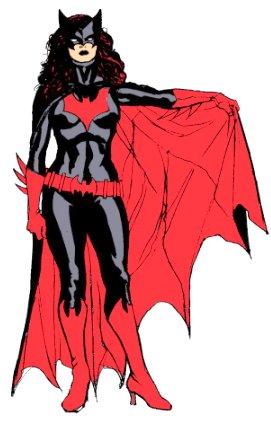
And now comes word that Batwoman, a character first introduced in a 1956 issue of Detective Comics, but who hasn’t been seen since she was murdered by the League of Assassins in a 1979 edition of that same comic book, is making a comeback--and a statement about the sorts of people who can become superheroes in the 21st century. For a DC Comics graphic-novel limited series entitled 52, which debuted in mid-May and will run to 52 weekly installments over the next year, Batwoman has been vastly re-imagined as a “‘lipstick lesbian’ who moonlights as a crime fighter.” (Holy personality change, Batman!) The character who Batman co-creator Bob Kane once claimed was based on his wife--thus Batwoman’s true identity, Kathy Kane--is now, according to DC publicity, “a rich socialite who has a romantic history with another 52 character, [Gotham City] ex-police detective Renee Montoya,” and dresses in a curves-hugging black-and-red outfit that not only resembles what Batgirl (played by Yvonne Craig) wore on television, but beats the silk drawers off the yellow, black, and red costume--complete with “utility purse”--that artist Kane gave her originally.
According to a BBC News report,
The new-look Batwoman is just one of a wave of ethnically and sexually diverse characters entering the DC Comics universe.
Others include Mexican teenager Blue Beetle--who replaces the character’s previous white incarnation--and the Great Ten, a government-sponsored team of Chinese superheroes.
Regular characters Firestorm and The Atom, meanwhile, have been reinvented as black and Asian heroes respectively.
The characters are part of a wider effort to broaden the make-up of comic-book creations in line with society as a whole.
So, does this mean that Batman and Robin can finally come out as the gay lovers they’ve long been rumored to be? Probably not.
[[M I L E S T O N E S]]* I can’t let today pass without noting that it was on this date, 40 years ago, that the campy but beloved ABC-TV series Batman debuted, starring Adam West and Burt Ward. Although it was based on the comic-book character created by artist Bob Kane in 1939, the half-hour series bore little of the darkness inherent in Kane’s work. Instead, it capitalized on action (lots of fight scenes with “KAPOW!” and “SOCK!” splashed across the small screen in vivid hues) and light romance (Batman seemed always on the edge of being seduced by that purr-fidious felon Catwoman, and Robin looked like a likely candidate for canoodling with Batgirl [played by the lovely Yvonne Craig]), as well as noteworthy guest appearances by Frank Gorshin (as The Riddler), Burgess Meredith (as The Penguin), Roddy McDowell (as The Bookworm), Cesar Romero (as The Joker), and numerous others. (Interestingly, as Wikipedia reports, so many Hollywood heavyweights were hungry for cameos or larger roles in the series, that some, like Elizabeth Taylor, had to be turned away.)
With its catchy, Nelson Riddle theme song (click here), cool Batmobile and gadget-packed Batcave, and two-part-episode cliffhangers, Batman became something of a TV legend, helping to inspire comic strips, books, cartoon shows, video games, theme park rides, and half a dozen theatrical movies (from a parodyish 1966 West-Ward spinoff from the series to last year’s Batman Begins). Given its impact on small-screen history, it’s stunning to remember that this series only lasted from 1966 to 1968 (showing twice a week during its first two seasons). In response to falling ratings, ABC eventually cut the series’ budget and even sought to eliminate the character of Robin, and turn the more adult-attracting Batgirl into the Caped Crusader’s sidekick. After West and series developer Wayne Dozier objected, the network decided to cancel the show. Rival NBC-TV subsequently proposed picking it up, and even returning it to a twice-weekly schedule, but withdrew its offer after learning that the show’s sets had been demolished.
With the Adventures of Superman now available on DVD, perhaps we can look forward to Batman finally being released in the same format. Stay tuned for more--same Bat-time, same Bat-channel.
Check out The Rap Sheet’s picks of more than 400 books for crime, mystery, and thriller lovers, all due to be released between now and New Year’s Day. Click here.
From time to time, Limbo features short video clips. Use of these is for historical and entertainment purposes only, and is not meant to establish ownership of such materials. Rights to those clips stay with their owners/creators.