Showing posts with label Star Trek. Show all posts

Thursday, September 08, 2016

Five Years, 50 Years—Mission Accomplished


Tonight marks 50 years since the debut of the NBC-TV series Star Trek. Terence Towles Canote has a nice in-depth post up about this anniversary, which notes that
Since September 8, 1966, Star Trek has become the stuff of television legends. It was the low-rated science-fiction show saved by its fans from cancellation that became a phenomenon in syndicated reruns. While there is some truth to the legend (in its initial network run Star Trek’s ratings were always moderate to low), there is much about the legend that simply isn’t true. Indeed, even while in its first run there were signs that Star Trek was on its way to becoming a phenomenon.
Comic-book writer Christopher Mills offers his own thoughts on the show, in Atomic Pulp, explaining that the original, 1966-1969 Trek “inspired and informed the person I became.
I learned the value of reason and logic from an alien with pointed ears and a Satanic visage. I learned the nobility of humanity and compassion toward all life, regardless of shape, color or form, from an anachronistic Southern medic. And, most importantly, I learned about the worth of boldness, courage, and tempered wisdom from a charming leader with a confident swagger sporting a gold tunic. [Captain James T.] Kirk was a fighter, a diplomat, a philosopher—and a libidinous wolf—but in my eyes, he was the best of us as a species. He wasn’t perfect—and to his credit, usually admitted his flaws and acknowledged his mistakes—but he was also a man of intelligence and action, who sought out brave new worlds and always had his eye on the future.
My own experience with Star Trek didn’t begin until the early 1970s, when I was old enough and aware enough to appreciate television. To my mother’s regret and my father’s everlasting bewilderment, I became a Trek fan for life as a result of watching reruns of that series’ original 79 episodes about a multi-cultural crew of explorers who raced across the galaxy in a sleek starship, bringing help to humans and aliens in need, and taking with them a message of hope and love and peace. (It didn’t hurt, either, that there was the occasional Orion dancing girl to catch a young boy’s eye!) I have since seen all of the Star Trek spinoffs and every Trek movie save the most recent one. I even went with my niece one year to a Trek convention, during which I had the pleasure of listening to William Shatner recount his hilarious experience in traveling to Seattle for that event.

I think creator Gene Roddenberry’s vision for Star Trek has been greatly enhanced and deepened by some of the people who took over the franchise after his death in 1991, particularly executive producer Rick Berman. Yet Roddenberry gave television watchers the blueprint, and even half a century later, his “Wagon Train to the stars” is as durable and promising and hopeful as ever.

Live long and prosper, my fellow Star Trek fans!

READ MORE:To Boldly Imagine: Star Trek’s Half Century,” by Andrew Liptak (Kirkus Reviews); “Star Trek’s Still as Relevant on the 50th Anniversary,” by Dave Marinaccio (Bookgasm); “The Mission to Restore the Original Starship Enterprise,” by Jackie Mansky (Smithsonian); “Star Trek at 50: The Theme Song Has Lyrics. No, Really,” by Chris Barton (Los Angeles Times).

Friday, February 27, 2015

Good-bye, Leonard Nimoy (1931-2015)


READ MORE:Leonard Nimoy, Spock of Star Trek, Dies at 83,” by Virginia Heffernan (The New York Times); “Star Trek Is Great, and Leonard Nimoy’s Spock Was the Greatest Thing About It,” by Matthew Yglesias (Vox); “Leonard Nimoy, R.I.P.,” by Michael Hadley (It’s About TV!); “Mort: Mr. Spock,” by Don Herron (Up and Down These Mean Streets); “A Word About Leonard Nimoy,” by Jeri Westerson (Getting Medieval); “The Iconic ‘Live Long and Prosper’ Hand Gesture Was Originally a Jewish Sign,” by Daven Hiskey (Today I Found Out); “How Leonard Nimoy Made Spock an American Jewish Icon,” by Matthew Rozsa (Salon); “Leonard Nimoy Dies at 83, Dabbled in Spy Entertainment,” by Bill Koenig (The Spy Command); “R.I.P., Leonard Nimoy: We’ll Always Have Paris,” by Matthew Bradford/Tanner (Double O Section); “Leonard Nimoy, You Will Be Sorely Missed,” by Paul Morris (Little Things); “‘I Have Been--and Always Shall Be--Your Friend,’” by Josh Marshall (Talking Points Memo); “Remembering Leonard Nimoy, 1931-2015” (StarTrek.com).

Wednesday, September 18, 2013

Where No Fan Has Gone Before


Anybody who’s known me for a while understands that I’m a longtime Star Trek fans. So I was excited to learn about a new hardcover book, Star Trek: The Art of Juan Ortiz (Titan). It seems that Ortiz, an illustrator/designer for Disney and Warner Bros., has spent years developing movie-style posters for all 79 episodes (plus the pilot) of the original Star Trek TV series. “Drawing inspiration from pulp book covers, advertisements, comic books, and ’60s movie posters, the achievement is impressive to Trekkies and ’60s design fans alike,” says Flavorwire in its look at Ortiz’s efforts.

The poster above was inspired by the “space hippies” episode, “The Way to Eden,” broadcast originally on February 21, 1969.

READ MORE:All 80 Original Episodes of the Original Star Trek TV Show,” by Robert Newman (Newmanology).

Tuesday, October 02, 2012

Quite a Trip

Last month brought the 46th anniversary of Star Trek’s debut on NBC-TV. However, it was only yesterday that I discovered, on The Booksteve Channel, Cleveland Amory’s review of that show in TV Guide. Blogger Steven Thompson’s scan of the page is rather crooked, and it doesn’t include the publication date, but the piece couldn’t have been published too long after the show was first broadcast on September 8, 1966. Amory was not altogether thrilled with Star Trek (he thought it better fare for children than adults), but his critique makes a fine artifact for today’s myriad fans.

Right-click the image to open an enlargement.

Saturday, September 08, 2012

Finding the Future in the Past

Happy anniversary to the original Star Trek series! That “Wagon Train to the stars,” as creator Gene Roddenberry described it, debuted as part of NBC-TV’s prime-time schedule on September 8, 1966--46 years ago today. Google celebrates this occasion with a special homepage doodle, while Steven Thompson breaks out some Star Trek memorabilia to herald the show’s cultural impact.

Wednesday, February 15, 2012

Happy Birthday, Andrea ... Er, Sherry

One of the most startling results of time’s relentless passage is when you wake up and realize that somebody you lusted after in your youth has suddenly turned, well, old. That phenomenon struck me when actress Susan Saint James, of McMillan & Wife fame, celebrated her 60th birthday in 2006, and again when The Avengers’ Diana Rigg turned 70 just two years after that. How could these small-screen beauties be clocking so many birthdays when I still thought of them as nubile 20-somethings?

I’m in the grip of that same peculiar nostalgia today, as I note the 70th birthday of Sherry Jackson.

Although this Idaho-born actress made her film debut at age 7, was featured in a few of the Ma and Pa Kettle comedies of the 1950s, and was a regular on The Danny Thomas Show (aka Make Room for Daddy) from 1953 to 1958, playing Thomas’ daughter, my immediate memory of Jackson always casts her as Andrea, the supposedly unemotional android she played in “What Are Little Girls Made Of?,” one of the earliest episodes of Star Trek. Andrea, as any veteran Trekkie can tell you, was the alluringly attired sexual companion of medical archaeologist Dr. Roger Korby, a man who once sparked the passions of the Enterprise’s Nurse Christine Chapel (Majel Barrett).

I’m embedding a significant scene from that episode below. Jackson is of course the chestnut-tressed, full-lipped, cleft-chinned temptress in the cleavage-showcasing crossover top:


When she shot that memorable episode, Jackson was a mere 24 years old. Yet that’s the way she remains in my mind’s eye.

During the decades since I first watched “What Are Little Girls Made Of?,” I’ve spotted her in a variety of other productions, from 77 Sunset Strip and Perry Mason to My Three Sons, Love, American Style, and The Rockford Files. She featured in two installments of the oft-campy TV series Batman, playing The Riddler’s once again skimpily outfitted cohort, Pauline. She guest-starred on Lost in Space, Matt Helm, The Streets of San Francisco, Barnaby Jones, Switch, and The Incredible Hulk; notched up two showings on The Wild Wild West; and did another turn with Star Trek’s William Shatner, this time playing a San Francisco casino dealer in his 1975-1976 TV series, The Barbary Coast.

Jackson was cast in Blake EdwardsGunn, a 1967 big-screen sequel to his TV series Peter Gunn (which included a tame nude scene--unfortunately cut from the U.S. version--and led to her appearance in Playboy), and then won the part of renowned comic-book news-gatherer Brenda Starr in a failed, 1979 TV pilot film, Brenda Starr, Reporter. The International Movie Database (IMDb) records her final screen performance as being in Casino, a 1980 teleflick starring Mannix’s Mike Connors.

Since that time, Jackson has remained largely out of the spotlight, though she did receive a star on the Hollywood Walk of Fame in 1980, and she shows up occasionally for fan events. There’s also an Official Sherry Jackson Website and Fanbase, where you’ll find photos and video segments from her appearances over the years.

To celebrate her 70th birthday today, I’ve tracked down a couple of fan-created videos to share with the rest of you. This first one compiles clips from The Twilight Zone, Lost in Space, Batman, The Wild Wild West, and naturally, Star Trek:


The second “tribute” assemblage features still photos of Jackson through the years, plus video clips from Star Trek (again), The Danny Thomas Show, Batman, The Rockford Files, Starsky & Hutch (on which she danced in a leopard-print bikini), and The Wild Wild West.


For leaving me with 40 years of wonderful memories, I salute you today, Sherry Jackson! In my mind, you will always be young and seductive-eyed, and look stunning in that crossover top.

READ MORE:Space Babe to Radio Guest” and “‘Make a Wish,’” by J. Kingston Pierce (The Rap Sheet); “From Baby Sherry to Sherry Baby: My Memorable Afternoon with Sherry Jackson,” “60’s Chic(k): The Retro Fantasy World of Sherry Jackson,” and “The Times--They Are A-Strange Thing: Sherry Jackson and the End of the 1960s,” by Mel Neuhaus (Examiner.com).

Thursday, September 08, 2011

Live Long and Prosper

Amazingly, it was 45 years ago today that the soon-to-be-famous series Star Trek debuted on NBC-TV.

Tuesday, February 03, 2009

Tuesday, April 15, 2008

I Smell Toast

I love these sorts of video-clip compilations. If you remember the original Star Trek, you’ll recall that variations on the line of dialogue “He’s dead, Jim,” were often delivered with maximum melodramatic effect. The Web site CollegeHumor has now collected many of those clips for your viewing entertainment. My favorite is the bit in which Doctor Leonard McCoy begins, “He was worse than dead”--and then tells why.

Watch the video compilation here.

Friday, September 08, 2006

Where No TV Series Has Gone Before


[[M I L E S T O N E S]] * Who would’ve thought, after the original Star Trek TV series was abruptly cancelled--just three years into its run--that the whole world would now be celebrating the 40th anniversary of its debut on September 8, 1966? But for those who discovered Gene Roddenberry’s final frontier either during the show’s initial broadcast, during repeats of that original series (which was my case), or as a result of the four series, 10 theatrical films, and one cartoon series that Star Trek spawned over the last four decades, the attraction was hard to miss.

Roddenberry originally conceived of his show as “a Wagon Train to the stars,” and there has always been a great deal of high adventure and the wide-eyed sense discovery to these series. However, Star Trek has evolved beyond a merely action-oriented and conflict-heavy concept, to embrace psychological issues, racial issues, and the xenophobia to be expected when so many different species come into contact with one another. Imparting too much philosophical importance to a TV series seems naïve; yet while Star Trek has been overwhelmingly a source of entertainment, it has also used the conventions and unconventionality of science fiction to tell stories that mirror the troubles and truths of the late 20th and early 21st century. The fact that space travelers 100, 300, and 400 years from now must deal with problems not so dissimilar from those facing people nowadays demonstrates the root fallibility of mankind, but also the expectation that what we think of now as insurmountable woes are, from the perspective of the far future, only matters to daunt but not defeat us. If there is any overriding message to Star Trek, it is that hopes survives.

And, it seems, so does the baby Roddenberry birthed on the small screen 40 years ago. As has been reported recently, an 11th Star Trek movie is on the drawing boards, to be produced by Lost co-creators J. J. Abrams and Damon Lindelof. Although I am concerned to see the franchise pass out of the hands of longtime steward Rick Berman, I can only be pleased that its longevity is ensured, at least in the short term. I grew up on Star Trek; I’d like to see future generations do the same.

May it live long and prosper, to quote a certain Vulcan.

Below: This version of the original Star Trek opening and closing features Alexander Courage’s famous theme music.


READ MORE:My Second-Favorite Trek ...,” by Christopher Mills (Atomic Pulp).

Tuesday, February 21, 2006

“Captain, I’m Giving It All I’ve Got”

[[F O L L O W - U P]] * James T. Kirk would surely have dismissed the Starship Enterprise’s chief engineer if he’d taken this damn long to carry out an assignment. It seems that the cremated ashes of actor James Doohan, who portrayed resourceful engineer Montgomery Scott, aka “Scotty,” on the original (1965-69) Star Trek TV series, and who died last July at age 85, have still not been dispatched into space. They’d previously been scheduled for transport in early December 2005. Reports are that the “cremains” are now set to blast off “sometime in March.” But we’ll wait to see if that actually happens.

Accompanying Scotty on this “last mission,” says the Associated Press, will be the ashes of Leroy Gordon “Gordo” Cooper Jr., a Mercury program astronaut who died in October 2004.

Friday, January 13, 2006

Assignment: Mirth

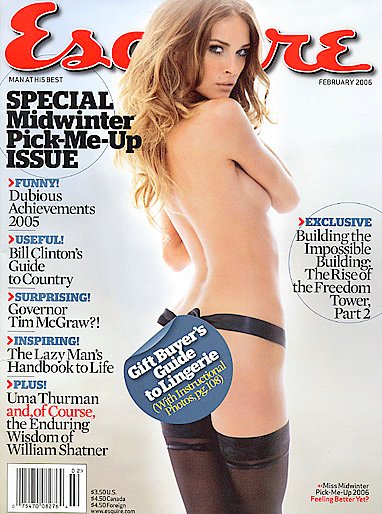
[[C E L E B S]] * OK, I confess that this item exists largely just so I can feature the cover of the February edition of Esquire. I mean, yowzah! However, mounted on top of model Erin Wasson in her skimpies (wait, that didn’t come out right), this issue also contains a profile of country singer Tim McGraw (in which the hardcore Democrat shares his interest in someday running for the governorship of Tennessee), a scattershot interview with Uma Thurman (“I certainly didn’t want to become a sensational sex symbol”), and the mag’s latest “Dubious Achievement Awards” section (this time including the inspired title of Jessica Simpson’s forthcoming memoir, I Want My Hymen Back: Ending My Marriage, Embracing My Family, and a reminder of how last year a onetime meteorologist at Idaho’s KPVI-TV “blamed Hurricane Katrina on the Japanese yakuza”).

Let’s not forget, either, Esquire’s Q&A with William Shatner, the 74-year-old former Captain James T. Kirk from Star Trek, who has made a rather remarkable comeback as sexist, gun-loving, and mad-cow-stricken shyster Denny Crane in Boston Legal. A few of the things he’s learned from life:

● “Sex should be a template for the day. You need to start slow and end completely.”
● “The line between making a total ass of yourself and being fundamentally funny is very narrow.”
● “We meet aliens every day who have something to give us. They come in the form of people with different opinions.”
● “Being an icon is overblown. Remember, and icon is moved by a mouse.”
● “Empathy is a learned characteristic. Some people take longer to learn it than others.”

And while we’re on the subject of Boston Legal ... Did anyone else notice, during last Tuesday’s episode, a scene in which Denny Crane flips open a new cell phone, only to have the damn thing chirp just like one of the communicators on the original Trek series? A marvelous in-joke!

Saturday, October 15, 2005

To the Moon, Scotty, to the Moon!

[[T R I B U T E S]] * How appropriate is this? The “cremains” of actor James Doohan, who played chief engineer Montgomery Scott on the original Star Trek TV series, and who died in July, will be launched into space in early December. According to the official Star Trek Web site, “it was Doohan’s wish that a portion of his cremated remains [7 grams in total] be shot into space, in similar fashion to [Star Trek creator] Gene Roddenberry in 1997. The ‘Memorial Spaceflight’ service is conducted by Space Services Inc. (SSI), based in Houston, Texas, and the flight containing Doohan’s ashes has been cleared for a launch window of December 6-12. It will take place at Vandenberg Air Force Base in Lompoc, California (on the coast about two hours north of Los Angeles).”

Reuters reports that Doohan’s vestiges will accompany the ashes of more than 120 others, “including those of an unidentified astronaut and Mareta West, the astrogeologist who determined the site for the first spacecraft landing on the moon.” The actor’s cremains, adds Reuters, “will be packed into a special tube that is ejected from the rocket and expected to orbit Earth for about 50 to 200 years before plunging into the planet’s atmosphere and burning up.” But, apparently, there’s no guarantee on that last point. As SSI spokeswoman Susan Schonfeld explains, Roddenberry’s remains fell back to Earth in 2002, a mere five years after they left.

What I hadn’t realized until now is just how common (though still expensive) “space burial” has become over the last decade. Evidently, “symbolic” samples of more than 150 people have preceded Doohan’s. It’s no longer where no man has gone before.

READ MORE:Space Ashes Recovered in N.M. Mountains” (AP).

Wednesday, July 20, 2005

Beam Scotty Up!

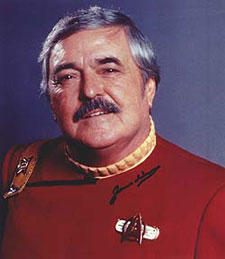
[[O B I T]] * I was sorry to hear about the death early this morning of James Doohan, the Canadian-born character actor who was certainly most famous for his role as chief engineer Montgomery Scott, aka "Scotty," on the original (1965-69) Star Trek TV series. He was 85 years old and had been living in Redmond, Washington (just east of Seattle), with his wife of 28 years, Wende.

Much to my parents’ dismay, I became an enthusiastic Trek fan sometime in the early 1970s, after NBC had pulled the plug on the show because of low ratings, but before it became the basis for a popular succession of movies, the inspiration for four additional TV series (including Star Trek: The Next Generation and the recently cancelled Star Trek: Enterprise), and the seed from which an ever-growing abundance of novels was born. I also had the chance, in 1997 to meet the actor himself, following that year’s publication of The Rising, Doohan’s introductory volume in what would be a trio of “Flight Engineer” novels, science-fiction tales (written with S.M. Stirling) that followed the adventures of Peter Raeder, a former ace space pilot who, after losing a hand, signs on as the flight engineer aboard the carrier Invincible. Doohan was then 77, but still evidently robust with life and, I remember, humble as hell, more than pleased to hear from an aging fan who had enjoyed his performances over the years. As I write this obit, my own copy of The Rising rests at my elbow.

Born in Vancouver, British Columbia, in 1920, Doohan (whose real middle name, it turns out, was Montgomery), escaped at age 19 from his heavy-drinking pharmacist father and unhappy childhood home, and joined the Royal Canadian Artillery during World War II. He lost the middle finger of his right hand amid the bloody D-Day invasion of France’s Normandy coast in June 1944--a fact that anyone who ever shook hands with him would know. After the war, Doohan moved to Toronto, Canada, where he took drama classes and eventually won a two-year scholarship to New York’s renowned Neighborhood Playhouse. Interestingly, his first TV series, Space Command (1953), was another SF odyssey, that one about “an international organization working to explore and colonize space.” According to the Internet Movie Database, he went on to appear in a number of movies, including the 1963 James Garner flick The Wheeler Dealers, before landing the role of Mr. Scott, the resourceful Scottish starship engineer, in the Gene Roddenberry-created Star Trek. After that, though, Doohan found himself terminally typecast--a truth that it took him some while to accept, but that he finally did, even using a memorable line from the original Trek series--Beam Me Up, Scotty--as the title of his 1996 autobiography. Asked in 1998 whether he ever wearied of hearing that same line pronounced repeatedly over the decades, Doohan replied with good humor, “I’m not tired of it at all. Good gracious, it’s been said to me for just about 31 years. It’s been said to me at 70 miles an hour across four lanes on the freeway. I hear it from just about everybody. It’s been fun.”

His most recent on-screen movie role was in the 1999 fantasy The Duke, although he is said to appear in a not-yet-released film called Actors in War. Doohan was awarded a star on Hollywood’s Walk of Fame in 2004. I hadn’t realized until reading more about this performer-novelist today that 2004 was also the year in which James Doohan pretty much disappeared from public sight, after being diagnosed with Alzheimer’s disease. His death is attributed to a combination of that and pneumonia.

Doohan’s face and familiar (if feigned) Scottish burr will be much missed in the world.

INTERESTING COINCIDENCE: It was exactly 36 years ago today that Apollo 11 astronaut Neil Armstrong earned his place in history as the first man to set foot on Earth’s moon.