Since I had been led to believe, only recently, that It Couldn’t Happen Here ...”--the pretty terrific blog devoted to that 1970s cult-TV series, Kolchak: The Night Stalker--would continue to offer new material for “a few more weeks,” I’m surprised by today’s announcement that it’s already shutting down, though not disappearing.
Over the last week, the site has added posts about three never-filmed Kolchak episodes (“Eve of Terror, “The Get of Belial,” and “The Executioner”), as well as Mark Dawidziak’s look back at the many books and graphic novels that either starred monster-hunting, seersucker-wearing reporter Carl Kolchak, or analyzed the original ABC-TV series. And today, David J. Schow recalls the very short-lived, 2005-2006 series reboot, The Night Stalker, which he notes “was cancelled right in the middle of a two-part episode, with four episodes unbroadcast until the series was re-run on the Sci Fi Channel in 2006.”
UPDATE: An index to all of the offerings in It Couldn’t Happen Here ..., complete with links, has now been established here.
If you haven’t been keeping up with It Couldn’t Happen Here ..., a short-run blog devoted to the 1970s TV series Kolchak: The Night Stalker, then you’ve definitely been missing out on some fun stuff. Yesterday’s focus was on the UFOs-oriented episode, “They Have Been, They Are, They Will Be ...” (see here and here), while today’sposts look at Episode No. 4, “The Vampire” (written by David Chase!), which inevitably alludes back to the 1972 Movie of the Week that started the whole Kolchak craze, The Night Stalker.
It Couldn’t Happen Here ... promises to follow all 20 Kolchak episodes, one every weekday. Which should take us at least through the month of January.
Break out the porkpie hat and cassette tape recorder again, along with the garlic cloves and silver bullets, because that monster-hunting investigative reporter, Carl Kolchak (Darren McGavin), is back! Online, at least.
I don’t know how much longer this will remain available, but at least for now, the unsold 1974 TV pilot film, The Questor Tapes--conceived and executive produced by Star Trek’s Gene Roddenberry, and still not available on DVD--can be watched on YouTube in its entirety. (It also appears to be available on that site in a 12-part collection of videos, beginning here.)
Not only is The Questor Tapes an interesting boob-tube artifact, but that science-fiction film about an android contains a surprise. Beginning at the 1:13 mark, we first hear a piece of music that will later become familiar as the main theme of Kolchak: The Night Stalker, starring Darren McGavin. (The introduction to Questor appears at the top of this post, while the Kolchak intro is embedded at left.) Sure enough, the composer responsible for the Kolchak theme, Gil Mellé, is also listed in the cast and crew credits for The Questor Tapes. Roddenberry’s teleflick debuted on NBC on January 23, 1974; Kolchak began its seven-month run on September 13, 1974.
Now, I can’t be the only one to have noticed this shared tune ...
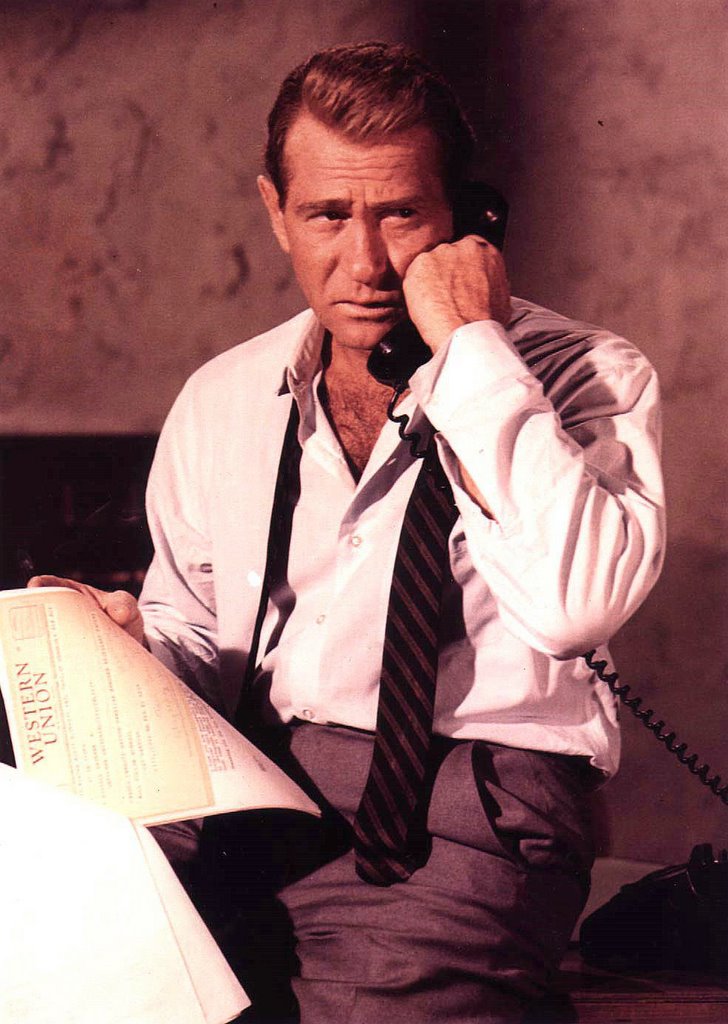
[[O B I T]]* Unlike the legendary monsters he slew under ... um, frightful conditions in the 1974 cult TV series Kolchak: The Night Stalker, actor Darren McGavin lived long enough to receive both public and professional acclaim. However, he finally died yesterday at a Los Angeles-area hospital, brought down by natural causes at 83 years old and leaving behind a wealth of film and television work, including noteworthy appearances in the 1955 Katherine Hepburn film Summertime and 1984’s The Natural (headlined, of course, by Robert Redford), as well as starring roles in half a dozen small-screen series. McGavin reportedly made his last, though uncredited cameo turn as a reporter in the short-lived 2005 remake of The Night Stalker.
McGavin, who was apparently born William Leland Richardson on May 7, 1922, preferred to be circumspect about his boyhood. Sources disagree as to whether he was born in Spokane, Washington, or San Joaquin, California. According to the Associated Press, the actor “told TV Guide in 1973 that he was a constant runaway at 10 and 11, and as a teen lived in warehouses in Tacoma, Washington, and dodged the police and welfare workers. His parents vanished, he said.” After a year spent at the College of the Pacific in northern California, McGavin moved to L.A., where he found work painting signs at Columbia Pictures. He reportedly got his Hollywood “break” while laboring behind the scenes on the 1945 film A Song to Remember. McGavin recalled years later that, after being told by an agent that a minor role in that picture remained unfilled, “I climbed off a painter’s ladder and washed up at a nearby gas station. I returned through Columbia’s front gate with the agent.” Director Charles Vidor hired him for the part--which was a good thing, because shortly thereafter, McGavin’s paint foreman fired him from his crew.
The young actor soon relocated to New York City, where he studied at the Neighborhood Playhouse and the Actors Studio, and began taking parts in live TV dramas and Broadway stage productions. In 1951, he won his first TV series lead, replacing Richard Carlyle as a quick-fingered Manhattan newspaper shooter in Crime Photographer. But it was his supporting roles in a trio of 1955 movies--Summertime, Frank Sinatra’s The Man With the Golden Arm, and The Court-Martial of Billy Mitchell--that initially won McGavin wide renown. A year later, he returned as a leading man on the small screen, this time portraying Mickey Spillane’s familiar hard-fisted, liberal-drinking, skirt-chasing private eye in Mike Hammer, which TV Guide decried as “easily the worst series on TV.” McGavin was quoted in 1968 as acknowledging that his Hammer was “a dummy. I made 72 of those shows, and I thought it was a comedy. In fact, I played it camp. He was the kind of guy who would’ve waved the flag for George Wallace.”
Fortunately, that didn’t seem to harm McGavin’s career any. The actor went on to star in a third TV series, Riverboat (1959-61); appear on other shows, from Route 66 and Rawhide, to Ben Casey, Gunsmoke, and Mission: Impossible; and feature in films such as The Great Sioux Massacre (1965) and African Gold (1966). In 1967, he took on the role of ex-con-turned-private-eye Dave Ross in The Outsider, the pilot for what was subsequently picked up as a one-year, 26-episode TV crime series created by the legendary Roy Huggins (who, in the mid-1970s, would give television a far better remembered ex-con P.I., Jim Rockford of The Rockford Files). McGavin wasn’t wanting for TV employment after that, guest starring in three different roles on The Name of the Game; playing a police lieutenant in the pilot to what would be the sadly fleeting Robert Forster series Banyon; and showing up in Love, American Style, Mannix, and other series and movies-of-the-week.
But it was in 1972 that he first portrayed the character with whom he has since been best associated: Carl Kolchak. Introduced in that year’s wildly popular ABC-TV flick The Night Stalker, Kolchak was a seersucker-draped, camera-hung, loose-limbed and dogged reporter who, in the course of his work, managed to dig up--sometimes quite literally--monsters of increasingly bizarre stripe. In the ’72 film, he went after a modern-day vampire who was putting the chill on Las Vegas. A year later, in the sequel, The Night Strangler, Kolchak sought to run to earth a century-old alchemist who’d been murdering women and stealing their blood in Seattle. The concept was as campy as it was horrific, and TV Guide opined at the time that it was necessary to take the Kolchak yarns with “a grain of salt--and maybe a bag of garlic.” However, the success of those two movies convinced ABC to launch Kolchak: The Night Stalker as a series (see a promo spot here). It lasted 20 episodes (with others never produced), before the network finally drove a stake through its heart. It has since been reported, though, that Kolchak inspired the creation of a later, more successful supernatural series, The X Files.
After Kolchak, McGavin split his time between silver-screen and small-screen assignments. He captured roles in the films Airport ’77 (1977), Dead Heat (1988), and Billy Madison (1995), and guested on series such as Magnum, P.I., Highway to Heaven, Sisters, and The Commish. McGavin tried his hand, too, at a half-hour comedy series, the eminently forgettable Small & Frye (1983), in which he played a gumshoe partnered with a detective who could--wait for it--shrink himself down to only six inches in height. In 1976 he portrayed a would-be safecracker in the Disney film No Deposit, No Return opposite Don Knotts (who also died this weekend), and in 1980, McGavin played opposite Rock Hudson in the TV miniseries version of Ray Bradbury’s The Martian Chronicles. Three years later, he delivered the memorable part of testy, profanity-spouting “Old Man” Parker in what’s now considered a holiday comedy classic, the film A Christmas Story. And in 1990, he won the only Emmy Award of his career, for playing the part of Candice Bergen’s opinionated father on the TV series Murphy Brown.
McGavin was wed twice, the first time (in 1944) to a woman named Melanie York--a union that produced all four of his children, but ended in divorce in 1969. Soon after that split, the actor swapped “I dos” with a fellow TV regular 15 years his junior, Kathie Browne, who had guest starred in myriad series, from 77 Sunset Strip to The Wild, Wild West to Banacek. She even appeared opposite her husband in an installment of Kolchak, yet might still be most recognizable for her role as a beautiful, strangely “accelerated” alien in an episode of the original Star Trek series titled “Wink of an Eye.” Browne McGavin, who had survived breast cancer, died in April 2003 of natural causes.
It’s sad that such a gifted actor as Darren McGavin should disappear from our world. Equally unsettling, perhaps, is the realization that the character he once brought to life, Carl Kolchak--a man who, with his straw boater hat, tennis shoes, and Minox camera, was willing to go mano-a-monster with vampires, werewolves, belligerent aliens, and headless motorcycle crazies--is also now missing from our midst. We might all rest just a wee bit less easy tonight, as a result.
Below: The Kolchak opening, with theme by Gil Mellé.
Check out our selection of more than 400 works of mystery, crime, and thriller fiction—from both sides of the Atlantic—scheduled to reach bookstores between now and Labor Day. Click here.
From time to time, Limbo features short video clips. Use of these is for historical and entertainment purposes only, and is not meant to establish ownership of such materials. Rights to those clips stay with their owners/creators.

 I’m surprised by today’s announcement that it’s already shutting down, though not disappearing.