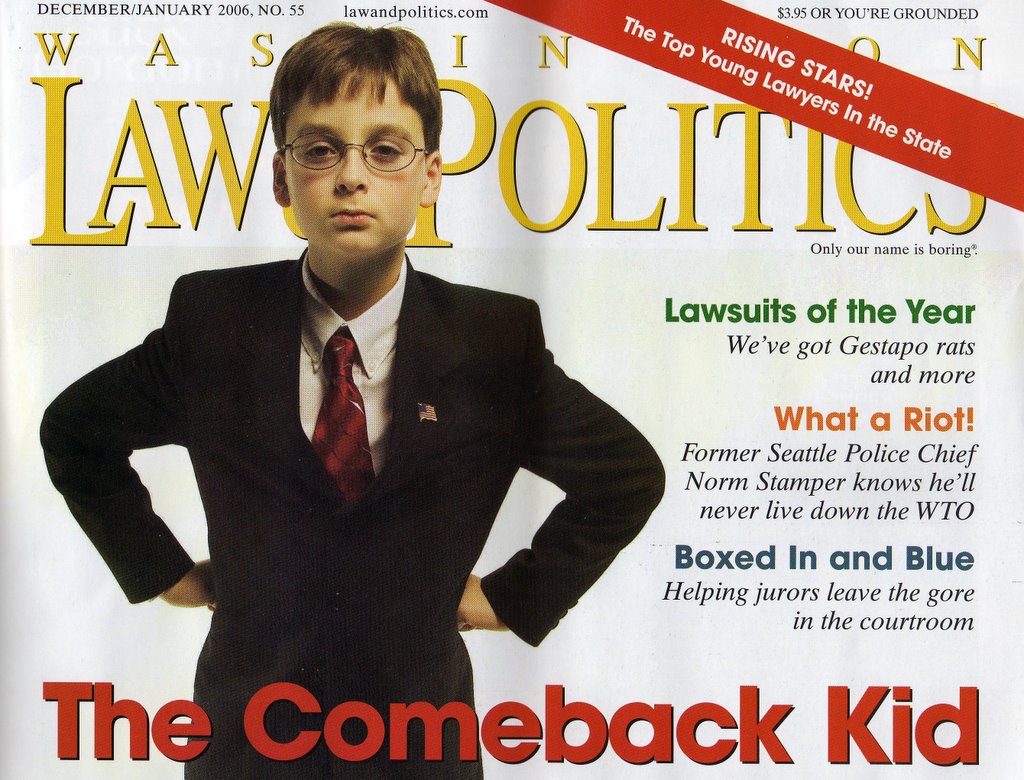
Showing posts with label Washington Law and Politics. Show all posts

Thursday, February 04, 2010

WL&P R.I.P.

This probably won’t mean much to the majority of Limbo readers, but it’s still sad news. From the Seattle news site Crosscut:
Washington Law & Politics, the feisty, informative quarterly magazine for lawyers in the state, will be folding. The last issue will be the Spring edition. Staff were informed yesterday. I’m sad to see it go, not only because I have been writing the political column there for the last few years, but because it lived up to its cheeky motto: “Only our name is boring.”

The news comes on the heels of word that its parent publication, Minnesota Law & Politics, has folded. The parent company, Key Professional Media of Minneapolis, kept the magazine going in part because of the success of its “Super Lawyers” and “Rising Stars” franchises, magazine features that rate attorneys and flourish from the competitive enthusiasm for self-promotion many lawyers and law firms possess. “Super Lawyers” and “Rising Stars” have been sold to Thomson Reuters which says they will continue to be published in all 50 states and Washington, D.C.
The whole article can be found here.

As Crosscut’s Knute Berger notes, I was a longtime contributor to Washington Law & Politics, at various times writing about historical presidential visits to the Evergreen State, interviewing U.S. Senator Maria Cantwell, reviewing the boom in local political blogs, and profiling former Seattle police chief Norm Stamper (a piece that won me a first-place award for government/political reporting from the Society of Professional Journalists). Prior to that, I was offered the WL&P editor’s post, but declined to take it. Unfortunately, that opportunity came just after my father had passed away in 2003, when I needed fewer responsibilities in my life for a while, rather than more.

The magazine wasn’t perfect; it had a consistently lackluster design and often focused on less-than-engaging personalities. But it did boast a bit of welcome irreverence, and for me, offered considerable writing freedom. I am definitely saddened by its sudden passing. And I want to thank editor Beth Taylor, along with co-founder Steve Kaplan and his executive editor, Adam Wahlberg, for their faith in me and for giving WL&P a better shot at success than many critics expected it would have when it launched back in 1997.

Tuesday, December 06, 2005

Stamper Has His Say


[[M E D I A]] * It’s not every day that a former big-city police chief opines that drugs should be legalized in the United States. But that’s precisely what Norm Stamper, who served for half a dozen years as the top cop in Seattle, Washington, did recently in The Seattle Times, writing:
I don’t favor decriminalization. I favor legalization, and not just of pot but of all drugs, including heroin, cocaine, meth, psychotropics, mushrooms and LSD.

Decriminalization, as my colleagues in the drug-reform movement hasten to inform me, takes the crime out of using drugs but continues to classify possession and use as a public offense, punishable by fines.

I’ve never understood why adults shouldn’t enjoy the same right to use verboten drugs as they have to suck on a Marlboro or knock back a scotch and water.

Prohibition of alcohol fell flat on its face. The prohibition of other drugs rests on an equally wobbly foundation. Not until we choose to frame responsible drug use--not an oxymoron in my dictionary--as a civil liberty will we be able to recognize the abuse of drugs, including alcohol, for what it is: a medical, not a criminal, matter.
As a follow-up to that editorial, let me point readers interested in Stamper to an interview I conducted with him, and that has just been published in Washington Law & Politics magazine. In it, the former chief not only damns capital punishment and America’s failed “war on drugs,” but talks about becoming a policeman, racism among cops, his fondness as a rookie for violence, and how what were supposed to have been peaceful demonstrations around the 1999 World Trade Organization (WTO) conference in Seattle went so very wrong. Read more.

Thursday, August 11, 2005

The Towns That Went Nuclear

[[H I S T O R Y]] * This is an uncommonly significant week when it comes to World War II remembrances. Last Sunday, August 6, marked the 60th anniversary of the U.S. atomic-bombing of Hiroshima, Japan. Three days later, residents of Nagasaki observed a moment of silence in memory of their city’s own atomic destruction, back on August 9, 1945. And this coming Sunday, August 14, brings the 60th anniversary of the day on which U.S. President Harry Truman announced that the war was finally over. There have already been numerous stories published in recollection of these events, but let me add one more to the list, this from the August/September issue of Washington Law & Politics magazine: “Nuke Town,” my history of the area around Hanford and White Bluffs, Washington, which had to be evacuated in the spring of 1943 to make room for a super-secret plutonium-manufacturing plant.

The Hanford facility was one of three across the country devoted to the A-bomb-developing “Manhattan Project” (the other two being a laboratory and testing grounds near Los Alamos, New Mexico, and a huge uranium separation complex at Oak Ridge, Tennessee). As I explain in the WL&P article, 1,200 Eastern Washingtonians had to be moved from their homes, farms, and orchards within a month’s time. Not until 1968--25 years after the government confiscated their property--were those people allowed to again see their hometowns, or what was left of them. Unfortunately, the online version of this story does not include the print magazine’s excellent photos of former Hanford-area residents, taken by Seattle’s Rick Dahms.

Thursday, July 21, 2005

The Senator from Safeco?

[[P O L I T I C S]] * No one who pays an ounce of attention to Washington state politics should have been surprised by news that Mike McGavick, who earlier this week announced he would step down as CEO of Seattle-based Safeco Insurance Company, has now decided to run for the U.S. Senate seat currently held by the state’s junior senator, Democrat Maria Cantwell. The 47-year-old McGavick is a veteran Republican insider and former top aide to Slade Gorton, the three-term solon whom Cantwell replaced after a close and fiercely contested race in 2000.

With former GOP state legislator Dino Rossi having already taken his name out of the running for the 2006 Senate campaign (after first failing in his drawn-out bid to overturn last year’s gubernatorial match, which he’d lost to Christine Gregoire after three ballot recounts), state Republican Party chairman Chris Vance was scouting around for someone who was both willing to challenge first-termer Cantwell and who might attract a broad following--without also drawing criticism for being too socially conservative in a state where the greatest electoral weight by far rests in liberal Seattle.

McGavick has already attracted some heavy-duty Republican supporters, including Gorton, former U.S. Representative Jennifer Dunn (a Newt Gingrich acolyte), and John Carlson, a conservative Seattle talk-radio host and the big-losing 2000 GOP candidate for governor. And a couple of potential GOP rivals for this Senate nomination have bowed out of the competition since McGavick’s announcement: former Representative Rick White (who, in 1994, beat then-House member Cantwell out of her seat) and Vance himself, who some wags thought wanted to be drafted into the coming race (despite his having lost miserably in his 2000 campaign for a U.S. House seat). For the blustering Republican chairman, the prospect of McGavick having a clear shot at Cantwell, without first being bloodied in an ideologically divisive primary campaign, might be almost as pleasing.

But, as I wrote recently in an article for Washington Law & Politics magazine, the 46-year-old Cantwell is a brainy, determined, and driven campaigner. She has elevated her public profile significantly over the last few years by squaring off against the Bush administration on issues ranging from energy rate hikes to defending Alaska’s Arctic National Wildlife Refuge (ANWR) from oil drillers, protecting privacy rights, and preserving Social Security (“the best anti-poverty program this country has ever put in place”) from Bush’s efforts to privatize the system. Hardly “just another liberal, cookie-cutter Democrat,” despite what Vance propagandizes to the media, Cantwell has established her ideological independence on a variety of fronts, which could prove crucial in attracting the rapidly growing number of swing voters among her constituents. University of Washington political science professor David Olson expects Cantwell to do well in the upcoming race, a forecast he bases in part on 2006 being a mid-term election year (“the president’s party”--in this case, the Republicans--“usually loses seats [in such elections], and that’s especially true for second-term presidents”), and partly on Cantwell’s gender. “If we’ve learned anything over the last 15 years,” he concludes, “it’s that women hold an electoral advantage in Washington.”

This Senate race may all come down to fund-raising, personal fortunes being spent (Cantwell made millions in high-tech; McGavick earned his own nut in bonuses paid for turning Safeco around as a business), face-to-face connections with voters (an area where the novice politician McGavick may find himself at some disadvantage), and the ability of the candidates to spread their respective messages. On top of those factors must be considered current unknowns, all of which could affect balloting: how voters will feel in the fall of 2006 about the war in Iraq, domestic economic conditions, and congressional actions; the continuing severity of Republican scandals and the state of Bush’s poll ratings; and blunders along the campaign trail (of which there are inevitably a few). Oh, and there’s always the choice Washingtonians will have to make between Cantwell the politician and McGavick the big-insurance exec. With today’s escalating costs of insurance, and industry resistance to covering the uninsured, and surveys showing that Capitol Hill dwellers are out of step with the priorities of Lunch Box America, it’s hard to tell which contender suffers the most in terms of professional respect.

Joel Connelly, the Seattle Post-Intelligencer’s longtime national political columnist, predicts this will be “a refreshing contest.” I’ll keep you posted.