
Showing posts with label Tom DeLay. Show all posts
Showing posts with label Tom DeLay. Show all posts
Thursday, July 19, 2007
Stupidest Statement (Yet) of the Week
“I contend [abortion] affects you in immigration. If we had those 40 million children that were killed over the last 30 years, we wouldn’t need the illegal immigrants to fill the jobs that they are doing today. Think about it.”--Disgraced former U.S. House majority leader Tom DeLay of Texas, speaking before a gathering of College Republicans


Wednesday, April 12, 2006
The New Comeback Kids?
[[G I G S]] * Two stories, direct from Limbo’s “How Clueless Can They Get?” file: First, U.S. News & World Report is saying that new White House chief of staff Josh Bolten, in his effort to resuscitate the much-scandalized and tired Bush administration, is thinking of hiring Tom DeLay, the indicted and recently retired former House majority leader, as director of the Office of Management and Budget (OMB). That’s the job Bolten himself held before replacing Andrew Card last month as chief of staff. U.S. News quotes an unnamed source as saying, “It would be a savvy move” to install in that job an “outsider with strong fiscal conservative credentials.” But DeLay? Remember, it was this Texas Republican strongman who made sure that skyrocketing federal budget deficits would be commonplace, that U.S. taxpayers would foot the bill for George W. Bush’s bungled war on Iraq to the tune of $100,000 per minute, and that repeated tax cuts for the wealthiest Americans would shift the greatest burden of taxation onto America’s middle class. This is somebody to be trusted when it comes to making important budget and fiscal management decisions? Are these people nuts? After so many politically motivated and cronyish hires, have the Busheviks finally dispensed with any intention whatsoever of filling jobs with the most capable people? And do they honestly believe that the American public would rest easier at night, knowing a potential felon like DeLay is helping to spend their hard-earned tax dollars? Fortunately, the ex-congressman isn’t a shoe-in for the OMB post. Also said to be in the running are deputy OMB director Joel Kaplan, U.S. trade representative Rob Portman, and Al Hubbard, director of the National Economic Council.
Second bit of news: The New Orleans Times-Picayune reports that St. Bernard Parish, one of the areas of south Louisiana worst hit by Hurricane Katrina last August, is looking to hire none other than Michael Brown, the disgraced former head of the Federal Emergency Management Agency (FEMA), to help local businesses and members of its community navigate the often choppy waters of the federal bureaucracy. Brown, who founded a consulting company after being expelled from his FEMA berth, is expected on Thursday to deliver his pitch for employment to the St. Bernard Parish council’s executive-finance committee. It “would be a mistake” to hire Brown, the Times-Picayune editorialized on Tuesday, adding:
Second bit of news: The New Orleans Times-Picayune reports that St. Bernard Parish, one of the areas of south Louisiana worst hit by Hurricane Katrina last August, is looking to hire none other than Michael Brown, the disgraced former head of the Federal Emergency Management Agency (FEMA), to help local businesses and members of its community navigate the often choppy waters of the federal bureaucracy. Brown, who founded a consulting company after being expelled from his FEMA berth, is expected on Thursday to deliver his pitch for employment to the St. Bernard Parish council’s executive-finance committee. It “would be a mistake” to hire Brown, the Times-Picayune editorialized on Tuesday, adding:
Parish Council members need to remember Mr. Brown’s abysmal performance during and after the hurricane. Granted, the former head of the Federal Emergency Management Agency had a better grasp on the gravity of Katrina than his vapid e-mails to staff members indicated. Those exchanges made him seem self-involved and clueless, but he did warn employees in a videoconference held before the storm that “this is a bad one and a big one.”Brown told the Houston Chronicle that “I can help make sure [the people of St. Bernard Parish] don’t get overlooked.” But Louisiana state Senator Walter Boasso, who represents St. Bernard, isn’t convinced. “Brown is just a sad reminder to my community of our needless loss of life and property,” he’s quoted in the Times-Picayune, “and we shouldn’t have to struggle with that reminder so soon in the midst of our rebuilding.” We’ll see what happens on Thursday, when a crowd is expected in the parish seat of Chalmette to protest Brown’s hiring.
Even so, nothing in Mr. Brown’s performance suggests that he’s the person who can make things happen for St. Bernard Parish. If he couldn’t get FEMA to work right when he was on the inside, before his forced resignation, how can he do so now, from the outside?
The agency seems every bit as dysfunctional now as it was during the storm, and it’s hard to believe that Mr. Brown’s familiarity with FEMA will make any difference in how much aid gets to St. Bernard Parish or how quickly.
Mr. Brown has been trying to rehabilitate his battered image since leaving FEMA by casting himself as the designated scapegoat. He’s criticized the decision to put the agency under the Department of Homeland Security, for instance, saying that its focus on terrorism made FEMA a stepchild.
That’s the reason he’s given for dealing directly with the White House during Katrina instead of going through Homeland Security Secretary Michael Chertoff.
But some who find that explanation persuasive still see Mr. Brown as well-intentioned but unqualified. Those are hardly the qualities St. Bernard Parish should be paying for at this critical time.
Thursday, April 06, 2006
Crime Pays
[[R E T I R E M E N T S]] * What color is Tom DeLay’s parachute? Green, apparently. According to today’s Houston Chronicle, even if the indicted Republican former House majority leader is convicted of campaign finance charges brought against him in Texas by Travis County District Attorney Ronnie Earle, as well as charges that may result from the continuing investigation of disgraced GOP “superlobbyist” Jack Abramoff, DeLay will still be eligible to receive “a congressional pension of nearly $67,000 a year.” The paper adds:
TRASH TALK: Want proof that DeLay’s really done? Click here.
The Sugar Land Republican, who will turn 59 on Saturday, would get a total of about $1.3 million in pension payouts in the next 20 years alone. DeLay also will be eligible to participate in the health plan available to all federal retirees.It seems The Hammer, who’s put in 21 years in Congress, staved off prosecution just long enough to qualify for early pension coverage. As the Chronicle explains,
Members of Congress are eligible for a pension at age 62 if they have completed at least five years of service. Members are eligible for a pension at age 50 if they have completed 20 years of service, or at any age after completing 25 years of service.DeLay’s annual payouts from the Federal Employees Retirement System will be significantly higher than the average of $46,908. But considering how much his tenure on Capitol Hill was costing the country, not only in terms of his personal salary but also factoring in his largely successful efforts to run up the budget deficit to cover tax cuts for the wealthiest Americans and the escalating charges associated with George W. Bush’s Iraq war, paying DeLay to leave ASAP might be considered a bargain.
The amount of the pension depends on years of service and the average of the highest three years of salary.
Members of Congress get $165,200 per year. As majority leader last year, DeLay was paid at annual rate of $180,100.
TRASH TALK: Want proof that DeLay’s really done? Click here.
Wednesday, April 05, 2006
Tom, Tom, the Deed Is Done
[[M O R E]] * There are plenty of fine follow-up stories today about Tom DeLay’s premature departure from Congress (see here, here, here, here, and here). But Steven Benen, of Carpetbagger Report fame, takes up one the most interesting topics--what will DeLay do next?--in an entry for The Huffington Post’s blog:
READ MORE: “Tom DeLay to Pursue Corruption in Private Sector” (The Onion); “I Remembered Tom DeLay,” by Joseph Hughes (Hughes for America).
DeLay told Time, for example, “I can do more on the outside of the House than I can on the inside right now. I want to continue to fight for the conservative cause. I want to continue to work for a Republican majority. It’s obvious to me over the last few months, I have tremendous support, not just in the 22nd District.” He also told the Galveston News, “I can continue to be a leader of the conservative cause.”An excellent question. Ol’ Tom may have a lot more free time on his hands after leaving Congress than he expects.
I realize that DeLay’s been under quite a strain lately, but if he seriously believes he’s going to be national conservative leader after he resigns from the House, he’s in deep, deep denial.
For one thing, he’s facing felony charges in Texas, and may soon be facing even more serious criminal charges in D.C. “Any rational person in his [DeLay’s] position would be very concerned,” said Kendall Coffey, a former federal prosecutor. ...
For another, DeLay seems confused about the source of his influence. He’s been a right-wing hero, but it came as a result of his ability to leverage the power of his office. DeLay ran the House with a clenched fist, demanded party loyalty, and punished anyone who strayed or got in his way. But without an office from which to rule, DeLay is a former bug-spray salesman who was forced to resign from Congress in disgrace. It’s not exactly the kind of development that launches a successful post-political career.
And lastly, there’s no real evidence that anyone, anywhere, wants him to “lead the conservative cause.” ...
Paul Weyrich, chairman of the Free Congress Foundation and a powerful conservative activist, didn’t see any room for DeLay in the top ranks of right-wing leaders outside D.C. “As an elected official, when he called conservatives together, he was in a position to do so,” Weyrich said. “On what basis does he operate from the outside?”
READ MORE: “Tom DeLay to Pursue Corruption in Private Sector” (The Onion); “I Remembered Tom DeLay,” by Joseph Hughes (Hughes for America).
Tuesday, April 04, 2006
We Come to Bury DeLay, Not to Praise Him
 [[P O L I T I C S]] * OK, that’s it. Hiatus over. Yes, I’ve been preoccupied lately with writing assignments that have absolutely nothing to do with Limbo. But today’s announcement that exterminator and former U.S. House majority leader Tom DeLay (R-Texas) is resigning from Congress after 21 years is too significant to let pass without comment. DeLay’s rather surprising announcement that he will leave his job before November’s midterm elections comes a little less than five months after he was indicted by a Texas grand jury on money-laundering and conspiracy charges related to the dispersal of $190,000 in corporate campaign contributions; just under four months after he gave up his leadership post in the Republican-dominated House; and only four days after his ex-deputy chief of staff, Tony C. Rudy, pleaded guilty to conspiring with now-notorious GOP lobbyist Jack Abramoff and another erstwhile DeLay aide, Michael Scanlon, to “corrupt public officials and defraud his clients,” as The Washington Post phrased it. Rudy agreed to cooperate with federal prosecutors investigating criminal enterprises that were run out of DeLay’s Capitol Hill office. As Joshua Micah Marshall of Talking Points Memo speculated this morning, “DeLay’s lawyers must have sat him down over the last 72 hours and explained to him that he needs to focus on not spending most of the rest of his life in prison.” Yet DeLay’s criminal defense lawyer, Richard Cullen, is quoted in The New York Times today as saying that “The decision had absolutely nothing to do with the investigation.”
Yeah, right. And if you believe that one, I’ve got this little ol’ bridge in New York City that I make you a deal on, cheap.
The print press and blogosphere are rife with DeLay post mortems. Representative John Boehner (R-Ohio), a former DeLay ally who’s also under investigation for his connections to Abramoff and other D.C. lobbyists, and who succeeded the Texas strongman as House majority leader, the No. 2 position in that body, said today that “The country owes Tom a great debt of gratitude for helping lead America in a new direction ... He has served our nation with integrity and honor, and I’m honored to call him my colleague and friend.” White House spokesman “Stonewall Scotty” McClellan--considerably practiced lately trying to put the best spin on bad news related to the GOP--told reporters that “Congressman DeLay has been a good ally with whom the president has worked to get things done for the people.” Meanwhile, right-wing bloggers excoriated Democrats for their undefined role in the congressman’s fall, as if the man known as The Hammer were some defenseless schoolgirl molested by opponents in waxed mustaches. “DeLay appears to be yet another victim of the Democrats’ politics of personal destruction--the only politics they know,” whined Power Line.
It’s certainly true that Democrats--whose resentment of DeLay can be traced to his participation in the 1998 partisan impeachment of President Bill Clinton, his manipulation of the 2000 presidential vote recount that placed George W. Bush in the Oval Office, his controversial (and possibly illegal) efforts to redistrict the state of Texas in order to augment the domination of Republicans in its congressional contingent, and his strong-arming of Bush-endorsed legislation (such as the costly and confusing Medicare drug benefit) through the House--are pleased by DeLay’s decision to step aside. In a mailing this morning, Democratic National Committee chair Howard Dean wrote:
DeLay is a symptom of a larger disease--a sick Republican culture of corruption that touches everyone who took his dirty money, voted for his corrupt leadership, or sat silently while their party has sold our government to the highest bidder. The corruption extends to the House, the Senate, and the Bush Administration--and this November the accountability must reach just as wide.A chorus of other left-leaning voices have chimed in since. In The Huffington Post, commentator Bill Press writes: “Whatever happens next, DeLay’s resignation is good for the Congress--and good for the country. Good for Congress because he was the poster boy for congressional corruption: more interested in lining his own pockets than serving the public. With him gone, maybe Congress can begin to clean up its own reputation. And DeLay’s departure is good for the country--because he represents the worst of American politics: a man who reeks of hate, greed, hypocrisy, false piety, and crime.” At TruthOut, William Rivers Pitt calls DeLay “the living embodiment of absolutely everything wrong in American politics. Forget your ideology, and your hateful divisiveness, and your shameless canoodling with the Taliban wing of fundamentalist Christianity. One cannot swing a cat by the tail in Washington, D.C., these days without smacking someone who thinks the way you do. ... No, your criminal misuse of the campaign funding laws, your outright disdain for the rules if they keep you from assuming absolute control, your almost Zen-like ability to operate beyond the confines of conscience and dignity, is why your presence has been a cancer on the body politic since the day you put down your bug extermination gear and tried a power tie on for size, and is why you’re finished now.” In a less caustic vein, Michael Tackett, opines in the Chicago Tribune’s politics blog, The Swamp, that DeLay’s departure represents the finishing gasp of the so-called Republican Revolution of the 1990s.
Now the “revolution” is more embers than flame. Most revolutions fail. This one lasted for more than a decade, but could not bridge the divide from revolution, with all its fervor, to evolution, putting the ideas into long-term practice. [Former House Speaker Newt] Gingrich seemed to wake up every morning with a list of 10 ideas, and even if half of them were unworkable, they created energy.Tackett adds that he’s disappointed, if not surprised, that supposed “realist” DeLay fails to acknowledge his own errors of judgment as contributing to his resignation, but attributes it instead to vicious attacks by members of “the Democrat Party,” who “would use his troubles to exploit political gains in races around the country in November.” (There are also DeLay supporters about charging that their man is being punished, martyr-like, for his born-again Christianity. Again, I have that bridge ...) Concludes Tackett: “Even though DeLay chose to go, it was not quietly. Nowhere in his words could one read [some] sense of contrition. That lack of acknowledgement is perhaps just one of the reasons that the revolution that DeLay rode to power seems to be struggling to breathe.”
But now, it is clear, the revolution also created hubris, first evidenced by Gingrich, who resigned in disgrace, and then by DeLay and his staff in their exercise of power. The staff seemed to forget the first rule of being good staff, namely to remember that your authority is entirely derived from the member. Instead, several of them decided to follow the well worn path from Capitol Hill to K Street, cashing in on their association with DeLay.
Now, the question is, what will become of Tom DeLay’s 22nd congressional district seat? The Hammer himself acknowledged today that he was stepping down for political, as much as legal, reasons. Although he managed to win his primary race in Texas, polls were already showing weakened support for DeLay in his race against former congressman Nick Lampson, the Democratic nominee. (A recent Houston Chronicle survey found that “nearly 40 percent of 501 likely voters in his district said their opinion of DeLay is less favorable than last year, compared with 11 percent who said their view of him has improved”--a change the Chronicle attributed in large part to DeLay’s advocacy last year in the circus-ish Terri Schiavo case.) Salon’s Farhad Manjoo suggests the campaign could go either of two ways from here on out: (1) Democrats might now withdraw their financial backing of Lampson, figuring that it will be much harder for him to run against a less-tainted Republican in a district that Bush won with 64 percent of the vote in 2004; or (2) “he’s golden, because now he may challenge a candidate who’s weaker than DeLay, and the lefty hordes will strengthen their support of his effort if only to spite DeLay.” The future of this congressional contest may depend on whether Texas holds a special election to choose somebody to fill out the remainder of DeLay’s 11th term--a vote that would give any GOP victor a substantial leg up on winning in November; or Lone State Republicans simply anoint another candidate to replace DeLay in the general election against Lampson. Two GOP-ers are lining up to be picked: Tom Campbell, a former general counsel for the National Oceanic and Atmospheric Administration, who won 30 percent of the vote against DeLay in the March primary race (while DeLay walked away with 62 percent); and David Wallace, the mayor of Sugar Land, Texas, DeLay’s hometown, who has “close ties” to Bob Perry, a prominent Republican fundraiser, longtime friend of White House political strategist Karl Rove, and a heavy contributor to the egregiously misnamed Swift Boat Veterans for Truth, which launched a smear campaign against Vietnam War hero John Kerry in 2004.
Undoubtedly, Republican strategists are hoping that Tom DeLay’s resignation will eliminate him as their party’s public face--the poster boy for the “culture of corruption” label with which Democrats hope to tar their rivals, and thus end 13 years of GOP control on Capitol Hill. But DeLay’s departure probably comes too late. Already, Gallup polling shows a dramatic shift in party loyalty among Americans, with 49 of respondents now calling themselves Democrats or leaning in that direction, while 42 percent define themselves as Republicans or lean that way. Just a year ago, the parties were even at 46 percent apiece. Furthermore, Dems continue to hold a substantial lead in generic balloting; a recent Time poll found that 50 percent of respondents would prefer to vote for a Democrat as their next congressperson, while only 41 percent chose Republican. Add to all of this well-publicized irritation over Bush among his congressional colleagues, debates about the need to censure (or impeach) the prez for approving an illegal domestic spying operation, rapidly declining support for Bush’s Iraq war (and the public abandonment of Bush by such stalwart conservatives as William F. Buckley, who calls the Iraq conflict a “failure”), skyrocketing budget deficits brought on by ill-timed tax cuts and untethered war spending, lingering displeasure over the Dubai Ports fiasco and brewing resentment over GOP efforts to criminalize undocumented workers coming into the United States, and of course the Abramoff scandal--which threatens to further expand its damage in Republican circles--and it’s no wonder that Republicans are worried as they look ahead to the November races. Odds are still against a Democratic takeover of Congress, thanks to the advantages of incumbency and a shortage of competitive races. Dems would need to pick up six more seats in the U.S. Senate to gain control of that body, or 15 seats in the House of Representatives to become the majority there (a daunting task, though not as difficult as winning 53 seats, which the GOP managed to do in its 1994, Gingrich-engineered upset).
However, the chances of such seismic shifts improve with each new Bush scandal, each new stumble by the Republican-dominated Congress, and each new example of presidential incompetence or breakdowns in GOP discipline. Midterm elections traditionally draw fewer voters than those in which a president is being elected, and recent prognostications suggest that small-government conservatives, upset by the fact that the federal government has actually grown substantially under Bush, and that there seems no end in sight to the costly and increasingly deadly Iraq conflict, might just stay home in November, increasing the impact made on races by Democrats and left-leaning independents. But a lot can change over the next seven months.
I suspect, though, that efforts to exploit Tom DeLay as the face of the modern Republican Party won’t change. At least not in the short term. Like Newt Gingrich before him, he’s a well-recognized symbol of arrogance, greed, and abuse of power. The man who once proclaimed hautily, in trying to get his way at a Ruth’s Chris Steak House, that “I am the federal government,” may no longer be drawing a congressional paycheck, but his influence on elections is expected to continue at least through November.
READ MORE: “DeLay’s Fall Won’t End Corruption Issue,” by John Whitesides (Reuters); “DeLay Resignation Unlikely to Affect Election-Year Dynamics,” by Steve Thomma (Knight Ridder); “A Surprise Move Leaves Texas Politics in Disarray,” by Ralph Blumenthal (The New York Times); “Exterminate Thyself: Decoding Tom DeLay’s Exit Interview,” by John Dickerson (Slate); “Tom DeLay’s Exit Is Big Loss for House GOP,” by Gail Russell Chaddock and Kris Axtman (The Christian Science Monitor); “Down Goes DeLay,” by Cenk Uygur (The Huffington Post); “Jack Cafferty on DeLay: ‘Cocky Little Bandy Rooster’” (Crooks & Liars); “Anti-Christian Conspirators Slay DeLay,” by Robert Scheer (TruthDig); “DeLay Reaction,” by Sonia Smith (Slate).
Saturday, January 07, 2006
Exit the Bugman
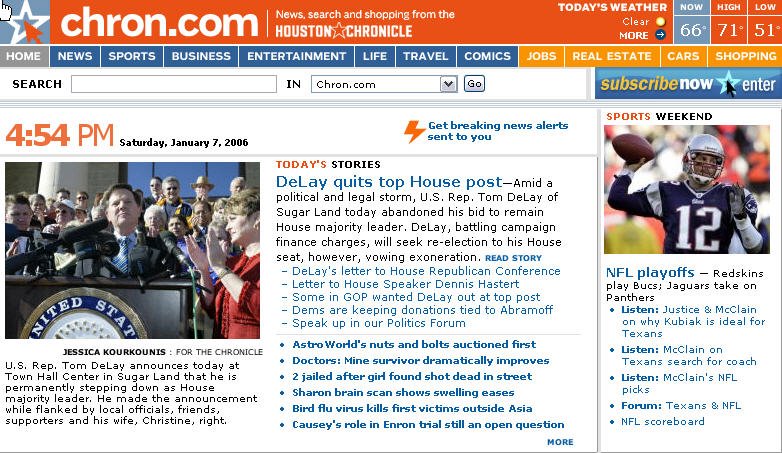
[[S C A N D A L S]] * Just a day after moderate Republicans in the U.S. House of Representatives began circulating a petition to permanently replace Tom DeLay (R-Texas) as their majority leader, the legislative strongman--who had at least temporarily relinquished his leadership post after being indicted for criminal wrongdoing in October, and is now under investigation for his involvement with disgraced GOP lobbyist Jack Abramoff--agreed to end his bid to regain that previous position.
In a brief, emotionless letter addressed to House Speaker Dennis Hastert (R-Illinois), DeLay wrote:
Dear Mr. Speaker,As John Aravosis of AMERICAblog explains, “What this move shows is that the damage to the Republican Party right now is significant. By shoving DeLay overboard, the Republicans clearly recognize that the ‘Culture of Corruption’ language has the potential to topple their House majority.” Meanwhile, The Stakeholder blog makes the excellent point that “DeLay was not kicked out for what he had done. He was kicked out for getting caught.” It might be all Tom DeLay can do now just to hold onto the congressional seat he’s occupied since the mid-1980s. Two former U.S. representatives from Texas--Democrat Nick Lampson and Steve Stockman, a Republican turned independent--are among eight candidates already declaring their intentions to replace DeLay in Congress, come January 2007. And polls show that 49 percent of registered voters in Texas’ 22nd District would pick a Democrat over DeLay in November’s midterm elections, while only 36 percent say they’re likely to support the incumbent.
I am writing to inform you of my decision to permanently step aside as majority leader, and of my belief that the best interests of the conference would be served by the election of a new leader as soon as possible.
The job of majority leader and the mandate of the Republican majority are too important to be hamstrung, even for a few months, by personal distractions.
I will continue to serve my constituents and seek re-election to a 12th term representing Texas’ 22nd district while I work to clear my name of the baseless charges leveled against me. I will also be reclaiming my seat on the Appropriations Committee when the second session of the 109th Congress convenes later this month.
Sincerely,
Tom DeLay
A vote on a new Republican majority leader will likely occur during the week of January 30, when the House finally reconvenes. Between now and then, “expect every possible fissure within the GOP caucus to surface and play itself out in a very public way,” writes Steve Benen of The Carpetbagger Report.
DELIVERING ACCESS: It looks as if there’s still more trouble ahead for exterminator turned politician DeLay. As The New York Times reports today, “Having secured a guilty plea from the lobbyist Jack Abramoff, prosecutors are entering a new phase of the corruption investigation in Washington and are focusing on a lobbying firm that may hold the key to whether Tom DeLay or other lawmakers will face criminal charges in the case.” That firm, the Alexander Strategy Group, “openly promoted the idea that it could deliver access” to the former majority leader. Read on.
NO LONGER MISSING LINKS: The Houston Chronicle has produced a handy PDF illustration showing the intricate connections between Jack Abramoff, Tom DeLay (and his wife, Christine), George W. Bush, ex-Christian Coalition chief (and present Republican candidate for lieutenant governor of Georgia) Ralph Reed, the Alexander Strategy Group, David H. Safavian (formerly in charge of procurement policy at Bush’s Office of Management and Budget, but arrested in September for “lying and obstructing” the government’s Abramoff probe), and others, both inside and outside of the nation’s capital. Click here to learn more.
IS NEY NEXT? Gannett News Service is quoting U.S. Representative Jim McCrery (R-Louisiana) as predicting that fellow congressman Bob Ney of Ohio, who has been linked to an Indian gambling scandal allegedly masterminded by Jack Abramoff, will “probably be indicted.” The five-term representative has already been subpoenaed by the Department of Justice in connection with its Abramoff investigation.
READ MORE: “DeLay Ends Bid to Regain Post as GOP Leader,” by Carl Hulse (The New York Times); “GOP Woes Don’t End With DeLay” (Associated Press); “Culture DeLay Helped Create May Have Been His Downfall,” by Julie Mason (Houston Chronicle); “Democrats Want Sweeping House Ethics Investigation” (Reuters); “The DeLay-Abramoff Money Trail,” by R. Jeffrey Smith (The Washington Post).
Friday, January 06, 2006
Don’t Let the Door Hit You on Your Way Out
[[P O L I T I C S]] * When even the ethically challenged Newt Gingrich thinks you’re too soiled with corruption to return to your position as majority leader of the U.S. House of Representatives, you know you’re cooked. So it would seem that the days of Tom DeLay (R-Texas) as the effective head of Congress’ lower chamber are over. Although his Republican cohorts had contrived to postpone the House’s reopening until late January, in order to give the indicted DeLay extra time to settle conspiracy and money-laundering charges brought against him in the Lone Star State, Republicans seem finally ready to concede that there’s no way for DeLay--who’s also been implicated in the Jack Abramoff bribery scandal--to return to his previous job without raising a ruckus both inside and outside of Washington, D.C., that might improve greatly chances of a Democratic takeover of the House next November. Earlier today, a petition began circulating in the House chamber to replace DeLay permanently as majority leader--even though the congressman himself hasn’t said he’ll relinquish his claim on the office. A minimum of 50 signatures is required to force an election, and the Capitol Hill paper Roll Call reports that more than a dozen House Republicans have already inked their monikers on the document. Expected to be in the running for DeLay’s old job are GOP Representatives Roy Blunt of Missouri, John Boehner of Ohio, and Eric Cantor of Virginia.
READ MORE: “Lobbyist’s Guilty Plea Seen as Threat to DeLay Return,” by Carl Hulse and Adam Nagourney (The New York Times); “In Reporting on House GOP Leadership Contest, AP Ignored Ethics Questions Facing Blunt, Boehner” (Media Matters).
READ MORE: “Lobbyist’s Guilty Plea Seen as Threat to DeLay Return,” by Carl Hulse and Adam Nagourney (The New York Times); “In Reporting on House GOP Leadership Contest, AP Ignored Ethics Questions Facing Blunt, Boehner” (Media Matters).
Wednesday, December 07, 2005
How Far the Mighty Have Fallen
[[C R I M E]] * And the news just keeps getting worse for Republican former House Majority Leader Tom DeLay of Texas. He had to step down from his congressional leadership post in September, following his indictment by a grand jury on charges of conspiracy and money laundering related to the dispersal of $190,000 in corporate campaign contributions. Then on Monday, a senior district judge in the Lone Star State dismissed the conspiracy indictment, but he let stand money-laundering charges against DeLay and a pair of his political associates, Jim Ellis and John Colyandro. The trio were indicted in connection with dispersals of corporate cash during the 2002 legislative races. (Under Texas law, it’s illegal for corporations to make donations to political races.)
As Salon’s War Room blog points out, the judge’s refusal to dismiss the money-laundering charges, and the possibility that DeLay’s trial could drag on for many months, means that the former Republican strongman’s chances of reclaiming his cozy majority leader’s seat are iffy, at best. Despite DeLay’s insistence that no plans are in the works to replace him permanently (he’s already been replaced temporarily by House Majority Whip Roy Blunt [R-Missouri]), The Washington Post reports that GOP backing for a leadership change is mounting. Republicans--already having to defend themselves against Democratic allegations that they’ve created a “culture of corruption” in the U.S. capital--fear that DeLay will next be “implicated in the bribery and corruption investigations of Republican lobbyist Jack Abramoff and former representative Randy “Duke” Cunningham (R-Calif.).” (DeLay may have passed up his best opportunity to keep the majority leader’s chair in October, when he rejected a plea bargain deal offered by Travis County, Texas, District Attorney Ronnie Earle.)
If all that bad news weren’t enough to wipe the grin off DeLay’s face, a CNN/USA Today/Gallup poll released this week shows that 49 percent of the voters in Texas’ solidly Republican 22nd congressional district--which DeLay has represented since 1984--are likely to vote for an unnamed Democratic candidate in next year’s midterm elections. Only 36 percent say they’ll support the embattled DeLay. The same survey found that 52 percent of his constituents now have an unfavorable view of the ex-House majority leader, while 37 percent view him favorably. DeLay has faced tough campaigns before, but as former Clinton adviser Paul Begala (who grew up in what’s now the Republican congressman’s district) muses at the TPM Café site, this time, “DeLay’s sleaze, combined with the quagmire in Iraq and Bush’s sinking approval, could prove fatal.”
UPDATE: The Boston Globe reports that U.S. House Speaker Dennis Hastert has scheduled the first House session of next year for January 31--two weeks after the Senate is set to resume work. As the Globe explains, this tardy start is designed specifically to give DeLay more time to “dispose of the charges” brought against him, if possible, and thereafter solidity support for his return to majority leader’s chair. “[N]ew leadership elections could not occur until the House is back in session,” the paper points out.
READ MORE: “How to Replace Tom DeLay: A Guide to Congressional Leadership Elections,” by Daniel Engber (Slate).
As Salon’s War Room blog points out, the judge’s refusal to dismiss the money-laundering charges, and the possibility that DeLay’s trial could drag on for many months, means that the former Republican strongman’s chances of reclaiming his cozy majority leader’s seat are iffy, at best. Despite DeLay’s insistence that no plans are in the works to replace him permanently (he’s already been replaced temporarily by House Majority Whip Roy Blunt [R-Missouri]), The Washington Post reports that GOP backing for a leadership change is mounting. Republicans--already having to defend themselves against Democratic allegations that they’ve created a “culture of corruption” in the U.S. capital--fear that DeLay will next be “implicated in the bribery and corruption investigations of Republican lobbyist Jack Abramoff and former representative Randy “Duke” Cunningham (R-Calif.).” (DeLay may have passed up his best opportunity to keep the majority leader’s chair in October, when he rejected a plea bargain deal offered by Travis County, Texas, District Attorney Ronnie Earle.)
If all that bad news weren’t enough to wipe the grin off DeLay’s face, a CNN/USA Today/Gallup poll released this week shows that 49 percent of the voters in Texas’ solidly Republican 22nd congressional district--which DeLay has represented since 1984--are likely to vote for an unnamed Democratic candidate in next year’s midterm elections. Only 36 percent say they’ll support the embattled DeLay. The same survey found that 52 percent of his constituents now have an unfavorable view of the ex-House majority leader, while 37 percent view him favorably. DeLay has faced tough campaigns before, but as former Clinton adviser Paul Begala (who grew up in what’s now the Republican congressman’s district) muses at the TPM Café site, this time, “DeLay’s sleaze, combined with the quagmire in Iraq and Bush’s sinking approval, could prove fatal.”
UPDATE: The Boston Globe reports that U.S. House Speaker Dennis Hastert has scheduled the first House session of next year for January 31--two weeks after the Senate is set to resume work. As the Globe explains, this tardy start is designed specifically to give DeLay more time to “dispose of the charges” brought against him, if possible, and thereafter solidity support for his return to majority leader’s chair. “[N]ew leadership elections could not occur until the House is back in session,” the paper points out.
READ MORE: “How to Replace Tom DeLay: A Guide to Congressional Leadership Elections,” by Daniel Engber (Slate).
Saturday, October 22, 2005
Why Is This Man Smiling?
 [[C R I M E]] * If you haven’t spotted this photo somewhere on the Web already, you just haven’t been paying attention. It’s the mug shot taken Thursday of former U.S. House Majority Leader Tom DeLay (R-Texas), after he turned himself in at a Harris County Sheriff’s Department facility in Houston, Texas. There, the Republican strongman was fingerprinted, photographed and hauled before a judge, before he was finally allowed to post bail in the amount of $10,000. As you’ll recall, DeLay is under indictment by a grand jury in Austin, charged with conspiracy and money laundering related to the dispersal of $190,000 in corporate campaign contributions. The allegation--which DeLay denies--is that his principal political action committee, Texans for a Republican Majority (TRMPAC) accepted that money, then flushed it through the Republican National Committee in order that it could be distributed among GOP candidates for the Texas Legislature in 2002. Lone State law prohibits such use of corporate funds by political campaigns. If convicted, DeLay could spend the rest his life in prison (not that anyone expects he will).
Meanwhile, get ready to see a whole lot more of DeLay’s mug shot. As The Hotline’s Marc Ambinder observes, “In nationalized midterm elections, images matter. (Remember the juxtaposition of Sen. Max Cleland and Osama Bin Laden?)” And you can be damn certain that Democrats will be nationalizing the 2006 midterm races, the same way Republicans did so successfully back in 1994. So in coming months you will find DeLay’s booking shot plastered across TV screens and billboards, as Democrats make the case, summarized quite well in this week’s New Yorker, that “the White House and Congress have handed government over to corrupt interests, and, in so doing, the Republicans have betrayed basic American principles of honesty, competence, and fairness.” DeLay, in other words, has become the poster boy for the GOP’s “culture of corruption.”
It’s only unfortunate, for those purposes, that DeLay’s mug shot doesn’t also show him in profile, draped with or holding identifying numbers, such as the old mug shots of John Dillinger and others. And that peculiarity has caused folks to wonder whether this smiling image of the former majority leader is an authentic mug shot. According to Slate’s typically wonderful “Explainer” column, the answer is yes.
[A]dvances in technology have made mug shots pretty much indistinguishable from normal photographs. During the last decade or so, most state and federal bond offices have made their entire booking process digital. (For one, most jurisdictions no longer take fingerprints using an ink pad but use biometric scans instead.) Mug shots now typically get taken with a digital camera. The accused’s personal identification number (those digits that used to appear on a placard in front of the arrestee’s torso) and other data like gender, eye color, and birth date, get recorded on the side of the photo. (You can see DeLay and his booking information in this uncropped version of the photo.)The scandalized DeLay made his first appearance in an Austin criminal court on Friday to answer the charges brought against him by a grand jury, assembled by Travis County District Attorney Ronnie Earle. Almost immediately, however, the proceedings were halted, after Republican DeLay’s lawyer claimed that the judge in this case should recuse himself because he’s given money in the past to Democratic candidates for office. Expect to see the defense continue in the future to complain that DeLay is the victim of a partisan vendetta, led by Earle, a Democrat, despite the DA’s long history of prosecuting influential Democrats as aggressively as he has Republicans.
Photographing criminals in profile was once considered essential. But since the advent of digital photography, the profile shot has become less common. (Practices vary from state to state, but Texas now takes only frontal pictures.) A side-angle photo once helped officers to identify criminals who tried to disguise themselves, as it’s more difficult to alter your profile than your face-forward appearance. However, now that computer programs are used to compare photographs instead of the naked eye, profile shots aren’t as useful.
READ MORE: “DeLay’s Arrest Warrant,” by Bob Geiger (Yellow Dog Blog); “I’m at Your Service, Mr. DeLay,” by Garrison Keillor (Salon); “Tom DeLay and the Bridge to Nowhere” (The New York Times).
Monday, October 03, 2005
DeLaying Tactics
[[F O L L O W - U P]] * Tom DeLay’s contention that he can continue to be a leader in the U.S. House of Representatives, despite his having been indicted last week on a charge of conspiracy to violate campaign-finance laws, sounds just a bit more hollow today, as a Texas grand jury today hands up two more charges against this 11-term Republican congressman: conspiring to launder money and money laundering. As the Associated Press notes, “The latter charge carries a penalty of up to life in prison.”
Meanwhile, news that both the Securities and Exchange Commission and the Department of Justice are now probing the stock dealings of Senate Majority Leader Bill Frist (R-Tennessee) leads New York Post columnist Christopher Byron to write: “Given the facts of what Frist actually did, and his preposterous after-the-fact explanations for them, the senior senator from Tennessee may go down in history as the Volunteer State’s biggest liar since Davy Crockett.”
READ MORE: “Power Outage,” by Karen Tumulty and Mike Allen (Time); “DeLay’s Influence Transcends His Title,” by Jeffrey H. Birnbaum and Jim VandeHei (The Washington Post); “DeLay Lawyers Move to Dismiss Charges,” by Laylan Copelin (Austin American-Statesman).
Meanwhile, news that both the Securities and Exchange Commission and the Department of Justice are now probing the stock dealings of Senate Majority Leader Bill Frist (R-Tennessee) leads New York Post columnist Christopher Byron to write: “Given the facts of what Frist actually did, and his preposterous after-the-fact explanations for them, the senior senator from Tennessee may go down in history as the Volunteer State’s biggest liar since Davy Crockett.”
READ MORE: “Power Outage,” by Karen Tumulty and Mike Allen (Time); “DeLay’s Influence Transcends His Title,” by Jeffrey H. Birnbaum and Jim VandeHei (The Washington Post); “DeLay Lawyers Move to Dismiss Charges,” by Laylan Copelin (Austin American-Statesman).
Sunday, October 02, 2005
Behold the Banana Republicans
 [[S C A N D A L S]] * Certainly, watching from beyond the Beltway, it appears that the chickens are finally coming home to roost at the White House. During a week when the Bush administration was hungry for some good press, and thought it could find that in the fairly easy confirmation and swearing-in of John G. Roberts Jr. as the 17th chief justice of the United States, all of the news seemed instead to be about six completely different--and, for George W. Bush, explosive--topics:
● Republican House Majority Leader Tom DeLay’s unanimous grand jury indictment on a charge of conspiracy to violate campaign-finance laws, ending what Newsweek columnist Jonathan Alter calls “the single most corrupt decade in the long and colorful history of the House of Representatives.” DeLay was forced last week to step down from his leadership position, and was replaced by Representative Roy D. Blunt (R-Missouri), a political protégé of former Attorney General John Ashcroft. DeLay is expected to be arraigned in Austin, Texas, on October 21.
● Republican Senate Majority Leader Bill Frist’s suspicious sale of his stock in HCA Inc., the nation’s largest for-profit hospital chain, which his family founded back in 1968. That transaction has prompted charges of insider trading and an investigation by the Securities and Exchange Commission, and may spell an end to Frist’s chances of running for president in 2008.
● Capitol Hill testimony by Michael D. Brown, the former head of the Federal Emergency Management Agency, whose heavily reported appearance--during which he excused FEMA’s poor performance in the wake of Hurricane Katrina by saying that “Louisiana was dysfunctional”--only served to remind Americans of the Bush administration’s arrogant disregard of warnings about natural disasters in New Orleans, and highlighted the prez’s inability to measure up even to the low expectations he has created for himself.
● A determination by investigators from the government’s General Accounting Office that the Bush administration “violated the law by buying favorable news coverage of President Bush’s education policies, by making payments to the conservative commentator Armstrong Williams, and by hiring a public relations company to analyze media perceptions of the Republican Party,” to quote The New York Times. The GAO said the White House had disseminated “covert propaganda” in the United States, in violation of a law that forbids federal money being spent “to produce or distribute a news story unless the government's role is openly acknowledged.”
● Worsening violence in Iraq and a New York federal judge’s order that the U.S. government release dozens of new photographs and videotapes showing the torture of Iraqi prisoners by American soldiers at Abu Ghraib--guaranteed to spark new denunciations of White House policy regarding the Iraq war.
● And finally, last week’s release of New York Times reporter Judith Miller. She’d been housed for 85 days at a Virginia detention center, following her refusal to appear before a grand jury investigating the 2003 disclosure of CIA agent Valerie Plame’s identity. Assured by her “source” that she was no longer bound by pledges of confidentiality, she gave her testimony on Friday to that grand jury, identifying I. Lewis “Scooter” Libby, Dick Cheney’s chief of staff, as the person who’d leaked Plame’s identity to her (although she ultimately never wrote any story about Plame). Libby thus became the second acknowledged White House informant regarding Plame, joining Bush political adviser Karl Rove (who’d previously been “outed” by Time magazine reporter Matthew Cooper) and strengthening allegations made by the operative’s husband, former Ambassador Joseph Wilson, that his wife’s cover was blown for the purposes of political retribution. In 2003, Wilson wrote a New York Times op-ed column in which he disputed claims by the administration that Iraqi leader Saddam Hussein was trying to procure uranium yellowcake from Niger that could be used in nuclear weapons.
“To be an honest Republican these days must be to wonder what awful revelation is coming next--and how the Grand Old Party, which once claimed to represent political reform, became a front for sleaze, corruption, and cynical criminality,” opines columnist Joe Conason in Salon. Indeed, the slippery slope of scandal on which Bush and his Republican cohorts perch looks to be longer and slicker with each new news cycle. It was only today, for instance, that George Stephanopoulos, a former communications director in the Clinton White House, who now hosts ABC-TV’s This Week, told his viewers about having learned from “a source close to” the Plame leak probe, that Bush and Cheney “were actually involved in some of these discussions” about leaking the Plame’s name. (See the video here.) If that’s true, reads a post at the left-leaning Think Progress Web site, it would “fundamentally change the dynamics” of the Plamegate scandal. “President Bush could no longer claim he was merely a bystander who wants to ‘get to the bottom of it.’ As Stephanopoulos notes, if Bush played a direct role it could make this scandal completely unmanageable.” (An article in Saturday’s New York Times lends further credence to Cheney’s Plamegate complicity.)
A Washington Post story from last weekend, talking primarily about Bush’s self-conscious efforts to “reclaim his swagger,” observed that the CIA leak investigation has left White House officials with “a general feeling of
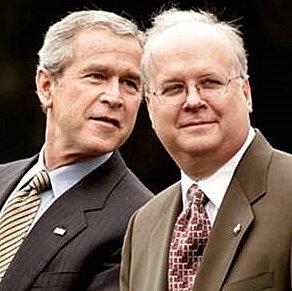 unease,” with aides “calling reporters to find out what was happening with Rove and the investigation.” (“‘Nobody knows what’s going to happen with the probe,’ one senior aide said.”) The same newspaper follows up today with an article that must be causing epidemic flop-sweats around the Oval Office. The Post says independent prosecutor Patrick Fitzgerald, who’s charged with making any legal cases against the Plame leakers and is expected to conclude his case later this month, is now “considering whether he can bring charges of a criminal conspiracy perpetrated by a group of senior Bush administration officials. Under this legal tactic, Fitzgerald would attempt to establish that at least two or more officials agreed to take affirmative steps to discredit and retaliate against Wilson and leak sensitive government information about his wife. To prove a criminal conspiracy, the actions need not have been criminal, but conspirators must have had a criminal purpose.”
At least for now, Bush seems to have halted the tumble of his job approval ratings, thanks in part to his appearing more ready and capable in dealing with Hurricane Rita last month than he did in responding to Katrina at the end of August. Newsweek’s latest poll finds that 40 percent of respondents now approve of the prez’s performance in office, as compared with his 38 percent approval in the same poll three weeks ago. However, the magazine reports, “a competence gap may be opening for the president.”
When given a choice, 49 percent of Americans in the new Newsweek Poll say Bush is “a bad manager who doesn’t know enough about what’s going on around him and below him.” Forty-three percent say he’s a “good manager who focuses on what’s important and delegates well.”Furthermore, poll ratings are fragile. Bush’s best hope may be to stay at arm’s length from the DeLay and Frist fiascos, and to hope that Michael Brown will shut up. But with Fitzgerald breathing down his neck, the prez may find himself dodging one cesspool, only to fall up to his neck in another. He’ll endeavor to regain some stature by naming a second Supreme Court nominee, this time to fill the seat of the retiring Sandra Day O’Connor; but with his base of right-wing extremists even more important in keeping his approval ratings from sinking into the toilet, Bush will feel obliged to kowtow to that constituency’s wishes--which means he’ll choose a significanty more conservative nominee than John Roberts. This will only reignite the debate over the Senate’s “nuclear option” on filibustering and, amidst the ensuing congressional scrum, leave voters with the perception that the Republican Party has tacked far to the right, less than a year before the 2006 midterm elections, when every office-seeker will want to be plumping his or her centrist, get-along credentials. And if indictments come down against White House rainmakers like Rove and Libby; or if the Iraq war gets bloodier still (there have already been 1,935 U.S. military casualties there since 2003); or if the economy goes south, or gas prices head into the stratosphere ... well, let’s just say that Bush’s near future is about as predictable as the impact of hurricanes. That’s even before you consider, as Newsweek’s Howard Fineman explains, that if DeLay is put on trial for conspiracy in Texas, that “could take place next summer, just before the midterm elections.”
More Americans still disapprove of the president’s handling of problems caused by Rita than approve (49 percent vs. 42 percent). And, across the board, most of his most visible policies only pull the support of a third of the country: on the economy, 35 percent approve; on Iraq, 33 percent; on energy policy, 28 percent.
More worrisome still, the base that provides the floor to the president’s support are critical of their own party these days. For instance, a 49-percent plurality of Republicans says their party is “too close to oil companies” and a 53-percent majority says it’s “too close to big business.”
“Thank God it’s not September 2006,” GOP consultant Scott W. Reed remarked recently to Business Week, adding that the ethics quicksand currently enveloping Republicans “has the potential for longer-term damage.” This may bode well for opposition Democrats, who are already crowing over surveys that find their stock climbing amid the GOP woes. For instance, a recent study by the Pew Research Center for the People and the Press found 52 percent of Americans saying that, if elections were held today, they’d vote for the Democratic candidate for Congress in their district, while only 40 percent say they’d mark their ballots for a Republican. Much of this increase in Democratic fortunes can be traced to self-described independents, who, Pew says, “decidedly favor the Democratic Party’s leadership across nearly all issues.”
But, as Slate’s chief political correspondent, John Dickerson, points out, “just because people are dissatisfied with Republicans doesn’t mean that they’re rushing into the warm arms of Democratic candidates. Yes, Democrats are seeing visions of 1994, but Newt Gingrich did more than just tear the face off of Democrats in leadership, he nurtured a farm team and presented a set of ideas that dovetailed with his political instinct for the jugular. Democrats have no Contract with America and have to find a Gingrich or some central figure to pitch their message.”
Any takers?
ADDENDUM: The London Observer weighs in on the DeLay scandal by assessing its impact upon British politics. Because of the Texas congressman’s indictment and resignation, writes Will Hutton, “American conservatism that has shaped American and British politics for 20 years has been holed below the waterline. It will take a lot more to sink it, but DeLay’s indictment is symptomatic of a conservative over-reach and endemic corruption that will trigger, at the very least, a retreat and maybe even more. One-Nation Tories and honest-to-God Labour politicians can take some succour; the right-wing wind that has blown across the Atlantic for nearly a generation is about to ease. Hypocrisies have been exposed. The discourse in British politics is set to change. ... U.S. politics moves in cycles. Once it was Republicans who were going to clean up corrupt Democrat Washington; now Democrats can champion the same cause. Nor can the media afford to be on the side of the Old Corruption; it’s bad for business. The wheel is turning, an important moment both sides of the Atlantic.”
READ MORE: “Just a Really Bad Stretch?,” by Todd S. Purdum (The New York Times); “Bush’s Presidency Is Exposed and Crumbling,” by Margaret Carlson (Bloomberg News); “Taking Sleaze to a New Level,” by Jonathan Chait (Los Angeles Times); “To the Cronies Go the Spoils,” by Gene Lyons (Arkansas Democrat Gazette); “GOP’s United Front Is Reduced to Veneer,” by Janet Hook (Los Angeles Times); “Troubled Year Gets Worse for the GOP,” by Dan Balz (The Washington Post); “Immoral Majority,” by Eugene Robinson (The Washington Post); “In the Beginning, There Was Abramoff,” by Frank Rich (The New York Times); “DeLay Indictment May Slow Donations” (AP); “The Hammer Falls,” by Michael Scherer (Salon); “The Exterminator,” by Evan Thomas, Holly Bailey and Michael Isikoff (Newsweek); “Defiant DeLay Sees Quick Return to U.S. Party Power” (Reuters); “Tom DeLay Is a Sideshow,” by Ryan Lizza (The New Republic); “Will DeLay Be Defeated Like Capone?” by Rick Casey (The Houston Chronicle); “The ‘American Street’ Speaks: Will the Democratic Party Listen?,” by Juan Cole (Salon); “Rally Round Rahm--Hooray for Ideas!,” by Jamal Simmons (The Huffington Post); “Bush Is Cooking Up Two More Wars,” by Paul Craig Roberts (Antiwar.com).
Sunday, September 25, 2005
Disgrace Under Fire
 [[S C A N D A L S]] * American history fails to provide an adequate predecessor to the trifecta of juicy political scandals that suddenly embroil the White House and the leaders of both houses of Congress. One must reach back all the way back to Ulysses S. Grant’s administration in the late 1860s and early ’70s to find a time when charges of corrupt conduct (the Crédit Mobilier scandal, the Sanborn Incident, the Whiskey Ring scandal, and the Belknap bribery scandal) were leveled against so many different branches of government in such quick succession. And even that doesn’t fully satisfy the criteria.
The longest-brewing of these outrages centers on House Majority Leader Tom DeLay (R-Texas), a hard-nosed disciplinarian (which explains his nickname, “The Hammer”), “born-again” Christian conservative, and former bug exterminator. He was rebuked last year by the House Ethics Committee after he swapped support for the congressional candidacy of a retiring Michigan House member’s son for that lawmaker’s vote in favor of the 2003 Medicare prescription drug benefit, and he later sullied himself badly during the Terri Schiavo fiasco, calling the removal of the brain-damaged woman’s feeding tube “an act of barbarism.” DeLay is currently the focus of an investigation based on allegations that his political action committee, Texans for a Republican Majority (TRMPAC), funnelled illegal corporate donations to Republican House candidates. And he’s been implicated in the Abramoff-Reed Indian Gambling Scandal, charged with receiving concert tickets and other illegal gifts, as well as the use a private skybox, from indicted Washington Republican lobbyist Jack Abramoff. (That’s the same Abramoff who was linked last week with the arrest of David H. Safavian, chief administrator at the federal procurement office in the White House Office of Management and Budget.)
Just two weeks ago, a couple of DeLay’s close political allies, former TRMPAC executive director John Colyandro and Jim Ellis, who heads the House leader’s Washington, D.C.-based Americans for a Republican Majority, were indicted on “felony charges of illegally using corporate money to elect Republicans in 2002,” as the Dallas Morning News reported. They “were charged with using $190,000 in corporate money to make campaign contributions to GOP candidates for the Texas House in what prosecutors say was an illegal money-laundering scheme.” More recently, a grand jury handed down indictments against several individual donors and three companies, including Tennessee-based Cracker Barrel, that had helped fund TRMPAC’s campaign with unlawful contributions. Although there’s been much speculation over whether DeLay’s indictment might be in the wind, the D.C. insider paper Roll Call says it’s unlikely, and Travis County, Texas, District Attorney Ronnie Earle, who’s been leading the campaign-finance probe, claims he can’t indict DeLay, because the congressman is “not in his jurisdiction.”
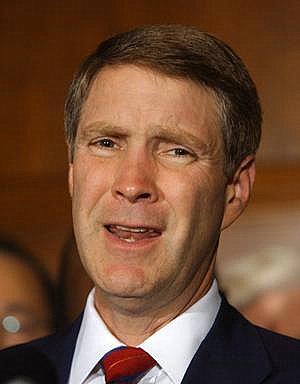 Meanwhile, at the other end of the U.S. Capitol, Senate Majority Leader Bill Frist (R-Tennessee) is being investigated by both the Justice Department and the Securities and Exchange Commission for possible insider trading. According to The Washington Post, Frist, a second-termer who’s been talked up as a potential GOP presidential candidate in 2008, “ordered his portfolio managers in June to sell his family’s shares in HCA Inc., the nation’s largest hospital chain,” which was founded in 1968 by Frist’s father and brother, together with a former owner of Kentucky Fried Chicken. “A month later, the stock’s price dropped 9 percent in a single day because of a warning from the company about weakening earnings. Stockholders are not permitted to trade stock based on inside information; whether Frist possessed any appears to be at the heart of the probes.” The majority leader’s spokespeople say that his HCA shares (valued in the hundreds of thousands of dollars) were being held in a blind trust, that Frist did not discuss this stock sale with HCA execs, and that he “had no information about the company or its performance that was not available to the public when he directed the trustees to sell the HCA stock.” The senator contends that he sold his HCA stock only to “eliminate the appearance of a conflict of interest.” However, the Associated Press says it has documents showing Frist “was updated several times about his investments in blind trusts during 2002, the last time two weeks before he publicly denied any knowledge of what was in the accounts.” That denial took place in a January 2003 TV interview, during which Frist said, “Well, I think really for our viewers it should be understood that I put this into a blind trust. So as far as I know, I own no HCA stock.” HCA acknowledged late last week that federal prosecutors have subpoenaed its records in quest of information related to the developing Frist scandal.
In what must be considered an understatement, Nashville’s Tennesseean newspaper suggests that insider-trading allegations “might pose a political stumbling block for the Tennessee Republican as he prepares a possible presidential campaign.” (Can you say “Martha Stewart”?)
Finally, of course, the Bush administration is still being buffetted by the CIA leak scandal, aka Plamegate. The kernel of this affair is a July 2003 column in the Chicago Sun-Times by longtime and right-leaning D.C. journalist Robert Novak. In that column, Novak identified Valerie Plame as “an Agency operative on weapons of mass destruction.” This was months after George W. Bush had delivered his 2003 State of the Union speech, in which he alleged that Iraqi leader Saddam Hussein was trying to procure uranium yellowcake from Niger that could be used in nuclear weapons; but it was only shortly after Plame’s husband, former Ambassador Joseph Wilson, wrote in a New York Times op-ed column that he had been dispatched by the CIA in 2002 to investigate the uranium claim, but had turned up nothing, leading him to believe “that some of the intelligence related to Iraq’s nuclear weapons program was twisted to exaggerate the Iraqi threat.” Novak has since acknowledged that he heard about Plame’s identity from “senior administration officials.” And Time magazine has revealed that deputy White House chief of staff Karl Rove spoke with reporters about Plame prior to Novak’s story appearing; Rove originally insisted he had discussed Plame only after the column’s publication. Wilson alleges that his wife was “outed” in partisan retaliation for his questioning administration statements regarding Hussein’s WMD resources. Besides Rove, other West Wing higher-ups said to have had a hand in revealing Plame’s name or the subsequent cover-up include vice-presidential chief of staff Lewis “Scooter” Libby, former White House press secretary Ari Fleisher, and John Bolton, who was recently installed (via a recess appointment) as Bush’s U.N. ambassador. (For a detailed timeline of Plamegate leaks and revelations, click here.)
This criminal investigation is now in the hands of Independent Counsel Patrick Fitzgerald, who is expected to wrap up the case this fall “in a final flurry of negotiations and legal maneuvering,” Reuters reports. The White House is understandably concerned. In The Washington Post’s piece this weekend about Bush’s attempts to regain his “swagger,” reporters Jim VandeHei and Peter Baker write that the CIA leak investigation has “seemed to distract officials and left a general feeling of unease ... Aides were calling reporters to find out what was happening with Rove and the investigation. ‘Nobody knows what’s going to happen with the probe,’ one senior aide said.” Bush’s job approval ratings, already driven down by mounting Iraq war violence and casualties, rising gas prices, the White House’s stumbling response to Hurricane Katrina, and the exorbitant costs of disaster recovery could take yet another dive should Rove or anybody else of consequence in the administration be indicted by Fitzgerald. Even in the absence of criminal prosecutions, a confirmation of White House involvement in a leak that arguably endangered national security would likely sour American voters further on the prez.
Which, combined with the DeLay and Frist scandals, is of significant concern to Republicans. The U.S. midterm elections are scheduled for a little more than 13 months from now, and polls already find 52 percent of Americans saying that they intend to vote for the Democratic candidate for Congress in their district, while only 40 percent say they’ll pull the level for a Republican. “The overall problem the Republican Party has is it is increasingly looking like Tammany Hall,” Marshall Wittman, a one-time conservative activist who now works for the centrist Democratic Leadership Council, tells the AP. “An odor of sleaziness is enveloping the Republicans and seeping into the administration.” As the Post puts it, the federal inquiries surrounding Bush, Frist, and DeLay “have handed Democrats a chance to broaden their long-stated claim that Republicans push ethical boundaries and focus on laws that help the rich.” This doesn’t guarantee widespread balance-of-power changes on Capitol Hill; Democrats still have more seats to defend in the Senate than the GOP must, and it might be a hard sell to portray every Republican office seeker next year as corrupted or corruptible.
Yet polls suggest growing public dissatisfaction with having all three branches of government under the control of a single political party. A similar level of displeasure filled the winds in 1994. That was the year Republicans, wielding their Contract with America, wrested control of both houses of Congress from Democrats for the first time since 1954.
FOLLOW-UP: “A Texas grand jury’s recent interest in conspiracy charges,” the Associated Press reports, “could lead to last-minute criminal indictments--possibly against House Majority Leader Tom DeLay--as it wraps up its investigation ... into DeLay’s state political organization, according to lawyers with knowledge of the case.” Read more.
ADDENDUM: Speaking of sleaze, the watchdog group Citizens for Responsibility and Ethics in Washington (CREW) this week releases its list of “the 13 most corrupt members of Congress.” The group says its goal is “to galvanize both the House Committee on Standards of Official Conduct and the Senate Select Committee on Ethics into action. The ethics committees have lain largely dormant over the past years despite the often appalling conduct of their members.” CREW’s roster of the ethically challenged contains not only Republicans, but a couple of Democrats as well:
- Senator Bill Frist (R-Tennessee)
- Representative Roy Blunt (R-Missouri)
- Senator Conrad Burns (R-Montana)
- Representative Bob Ney R-Ohio)
- Representative Tom Feeney (R-Florida)
- Representative Richard W. Pombo (R-California)
- Representative Maxine Waters (D-California)
- Senator Rick Santorum (R-Pennsylvania)
- Representative Randy “Duke” Cunningham (R-California)
- Representative William J. Jefferson (D-Louisiana)
- Representative Charles H. Taylor (R-North Carolina)
- Representative Marilyn N. Musgrave (R-Colorado)
- Representative Rick Renzi (R-Arizona)
CREW calls its report “Beyond DeLay: The 13 Most Corrupt Members of Congress,” to acknowledge the fact that it has already spoken out against the House leader’s multiple ethical lapses. The organization chose to focus its attention in this new report, however, on other members of the Senate and House “whose behavior merits scrutiny.”
READ MORE: “Will Frist Survive?,” by Jason Leopold (The Huffington Post); “Frist’s Political Future Darkens Over Questions on Stock Sales,” by Laura Litvan and Otis Bilodeau (Bloomberg); “Why Frist’s Lies Harm Bush’s Supreme Court Plans,” by Steve Soto (The Left Coaster); “Abramoff Probe May Threaten Leading Republicans as It Expands,” by Jonathan D. Salant (Bloomberg); “Bring Back Warren Harding,” by Frank Rich (The New York Times); “This Week in Corruption,” by Ryan White (TPM Café); “Hard Bigotry of No Expectations” (The New York Times); “The Broken Contract,” by Michael Ignatieff (The New York Times Magazine).
Subscribe to:
Posts (Atom)